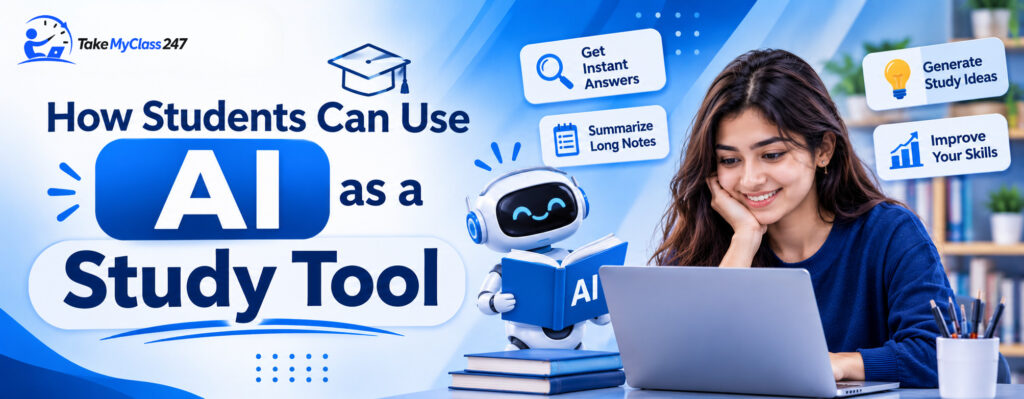
Students can use AI as a study tool in several ways. Specifically, AI makes learning more personalized and interactive by explaining ideas, structuring revision, creating questions, and discovering knowledge gaps. But when using AI tools, learners must always validate information, adhere to academic standards, and prioritize independent thinking.
Artificial Intelligence (AI) is transforming the way students learn, review, and prepare for tests. Rather than using AI to identify quick answers, learners may employ it as an interactive study assistant for explaining concepts, creating practice exercises, organizing tasks, and detecting gaps in their knowledge.
For example, a learner who is having difficulty understanding a concept from any area of science can request AI for clarification or ask for an example or exercise. At the same time, students who have to prepare for several exams can use an AI tool to design a realistic study timetable.
Overall, artificial intelligence is most effective in the context of active learning. Therefore, students must continue thinking independently, verify important information, use reliable academic sources, and comply with their institutions’ regulations. Read this blog if you are curious to know how students can use AI as a study tool.
What Is an AI Study Tool?
An AI study tool is software that uses artificial intelligence technology to assist students in learning, practicing, organizing, or revising their academic materials. The features of AI study tools vary from one to another. But overall, they help learners to describe concepts, summarize texts, formulate questions, provide writing feedback, or generate a study plan.
Personalization is one of the major strengths of AI technology. In general, artificial intelligence can tailor an explanation depending on the subject, level of understanding, and the exact question asked by the learner. For example, AI can explain a complex topic in simple language by using an analogy and step-by-step examples.
The most common AI study features include:
- Personalized explanations
- Generation of study plans
- Text summarization
- Creation of quizzes and questions
- Flashcard creation
- Writing assistance
- Practice tests
- Step-by-step problem solving
- Self-assessment of learning gaps
How Students Can Use AI as a Study Tool
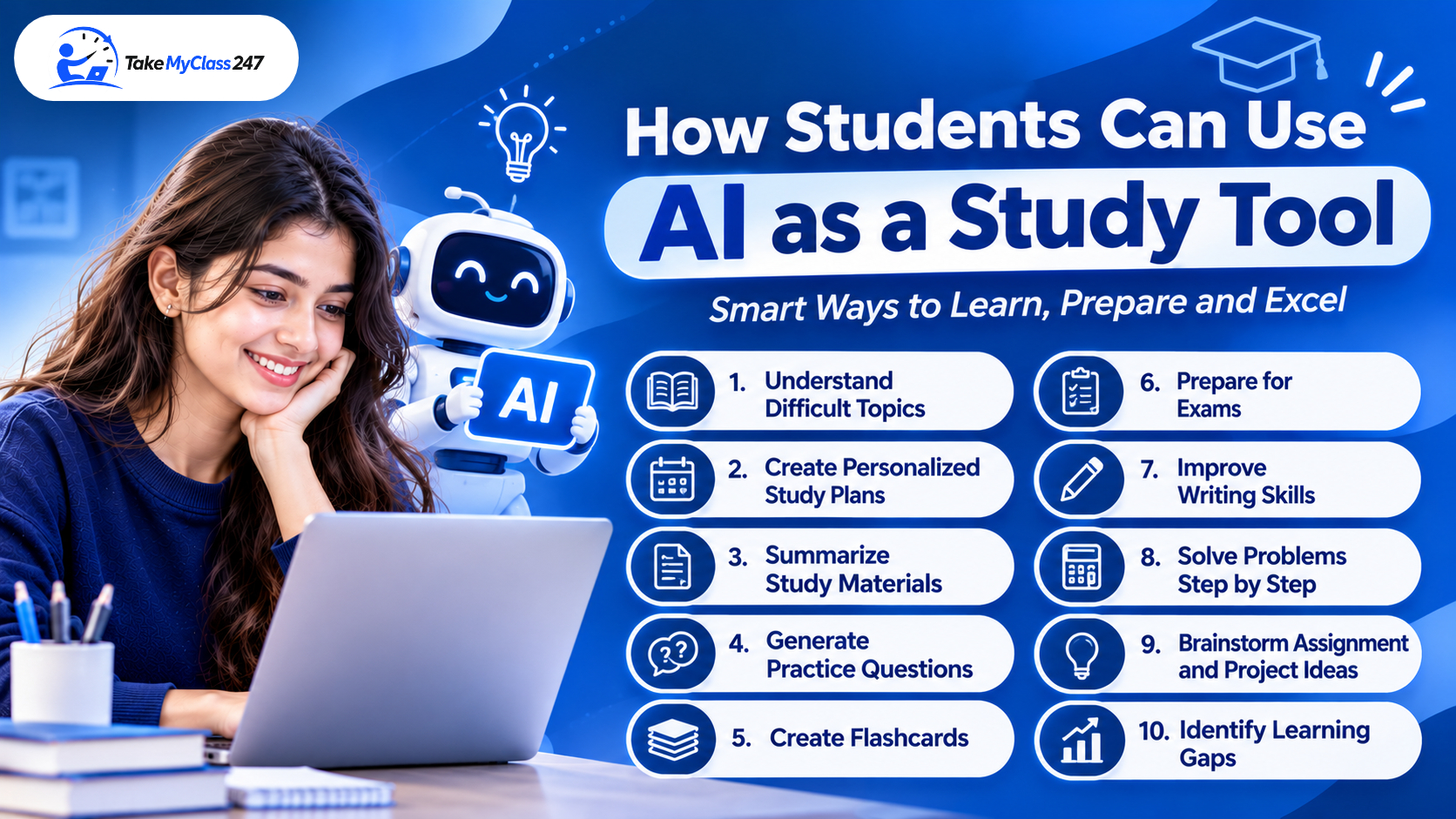
AI technology makes learning easier for students. These are some practical ways that help students to efficiently use AI as a study tool.
1. Understand Difficult Topics
Students can request AI to clarify challenging topics in easy-to-understand terms. If the explanation is hard to comprehend, then students can ask for an analogy, an application in real-life scenarios, or a sequential explanation.
For example, instead of directly requesting the solution to a physics problem, to get clear comprehension, one should ask AI to clarify the concept in the problem and explain the workings of each step.
2. Create Personalized Study Plans
With the help of AI, students can develop a customized study plan. If students give information about their subjects, exam date, time available to study, and other relevant preferences, AI will suggest an appropriate study schedule by dividing a big workload into smaller steps.
Usually, an efficient study plan would comprise breaks, revision time, and practice in addition to studying.
3. Summarize Study Materials
Sometimes it can be difficult for a student to read long chapters and lectures before the examination. The AI tool can transform any provided study material into a summary of revision points or key concepts.
However, a student needs to compare the summary with the original material because the AI tool may omit some vital information or misunderstand context.
4. Generate Practice Questions
Practice is one of the best ways for learners to check their knowledge. For this reason, they may ask the AI tool to create multiple-choice questions, quizzes, or short-answer exercises based on the particular topic.
But when practicing, students should try to answer the question before checking the explanations. This approach will make the activity a knowledge assessment instead of a passive reading experience.
5. Create Flashcards
Students can make flashcards with the help of AI tools to define terms and concepts, memorize formulas and dates, learn vocabulary, and other important facts. When creating flashcards, students can also even ask the tool to formulate questions for one side of the card and put the answers on the other.
Flashcards are effective, especially when students constantly revise difficult flashcards instead of learning information that they already know.
6. Prepare for Exams
AI tools support the exam preparation of students by creating mock tests, topic-based quizzes, revision notes, and practice sessions.
For example, while preparing for exams, students can ask AI to create a sample test consisting of 20 questions from three chapters, take the test without any assistance, and later revise the mistakes using the explanations provided.
7. Improve Writing Skills
Students can use AI to check grammar, sentence formation, clarity, organization, and the overall readability of writing. Also, AI has the ability to detect parts of arguments that may not make sense.
However, when using AI writing tools, students need to need to understand the recommended corrections rather than accept them blindly. Most importantly, learners can improve their writing skills only when they understand the reason behind the changes to sentences and paragraphs.
8. Solve Problems Step by Step
AI plays a key role in helping students solve math, science, programming, and technical problems by explaining the logic behind the solutions.
But while using AI for problem-solving, students should use prompts like, “How do I solve this step by step, and why is each step necessary?” instead of simply asking, “What is the answer?” This approach will help to get a detailed explanation, improve subject understanding, and make it easier to solve similar problems independently.
9. Brainstorm Assignment and Project Ideas
Furthermore, with the help of AI, students can brainstorm ideas related to the topic, research questions, and various approaches to the topic.
However, after brainstorming assignment ideas, the students need to complete independent research through credible sources. Most importantly, the ideas provided by AI should be used only as suggestions, and they should not replace the research itself.
10. Identify Learning Gaps
Students can also ask AI to generate a short quiz on some topic, and then use their results to find out knowledge gaps. If several questions concerning one particular concept are answered wrongly, then such a concept should be studied better.
It will make up a cycle of learning, testing, reviewing, knowledge gap identification, and testing once again.
Benefits of Using AI for Studying
AI will provide you with several practical benefits only when you use it wisely. These are some common advantages of using AI as a study tool
- Personalized learning support: AI will give specific explanations according to your needs.
- Faster revision: AI will make learning simpler for you by organizing lengthy course materials and summarizing them into key revision points.
- Interactive practice: You can interact with AI to generate questions and receive explanations.
- Better time management: AI will break down your tasks into smaller parts and enable you to schedule your studying activities according to your priorities and deadlines.
- Instant explanations: AI will aid you in researching complex topics without waiting until your next class.
- Improved study organization: AI will make it easier for you to clearly structure your notes, questions, revision tasks, and schedules.
How to Use AI Responsibly for Academic Success
AI usage in academics involves a lot of ethical issues. Hence, every student needs to use AI responsibly. These are some ethical ways of using AI that students should implement to succeed in their studies
- Firstly, students should verify AI-generated content, especially facts, stats, formulas, quotes, references, and technical data, before submission, as it may have wrong information.
- Secondly, students should strictly adhere to AI policies at their educational institution. Some institutions might allow the use of AI for ideation and proofreading assignments but prohibit its use for producing the entire work.
- Overall, students should use AI to learn instead of simply copying the answer the tool generates. Specifically, students can integrate AI with textbooks, classes, instructor instructions, libraries, and other credible sources.
- Finally, students should never input personal, financial, login, or confidential information about their studies in AI tools.
Common Mistakes Students Should Avoid When Using AI
Several practices can minimize the effectiveness of AI usage in education. Therefore, students should avoid
- Relying on AI entirely rather than learning independently
- Taking AI answers and using them as their answer to the assignment
- Blindly accepting wrong information without verifying it
- Using AI when the assignment and the educational institution forbid it
- Studying only AI summaries instead of studying actual material
Sometimes AI will generate answers that are not fully correct. Therefore, it is essential to think critically.
Tips for Getting Better Results from AI Study Tools
In general, giving clear and precise instructions to AI systems will help students obtain useful responses. Moreover, when interacting with AI, simply asking “Explain biology” may not provide the expected answer. Hence, it is important to ask for a clear explanation of a specific topic at a particular learning level.
In addition, students should also implement these practices to get better results from AI study tools
- Ask specific and clear questions.
- Give information about the subject, the learning level, and the type of help needed
- Request examples and explanations of the steps involved.
- Ask a list of follow-up questions when something is unclear.
- Ask AI to test instead of explaining the answer.
Overall, the learners who use AI for studying purposes can consider the responses of the tool as learning material after verification and not just as unquestioned answers.
Frequently Asked Questions
How can students use AI as a study tool?
With the use of AI, students can comprehend challenging subjects, create study plans, summarize information that is already provided, generate practice questions, make flashcards, prepare for exams, improve writing skills, and find learning gaps.
What are the best ways to use AI for studying?
The most useful approaches include those associated with active learning. Specifically, students can utilize AI for explaining concepts, testing their knowledge, getting step-by-step instructions, creating revision materials, and organizing study tasks.
Can AI create a personalized study plan?
Yes, it can. If students provide their subjects, deadlines, exam dates, available study hours, and priorities, then AI will propose a structured schedule. Later, students will need to customize it according to their workload and progress.
Can AI help students prepare for exams?
Yes, with the help of AI, students can prepare for their exams by creating mock tests, questions to practice, topic-related quizzes, revision guides, and explanations of complex concepts. However, they should make sure to verify content against their course materials.
Is using AI for studying considered cheating?
No, not necessarily. It completely depends on how students use AI and what the school, university, professor, or assignment guidelines allow. In most cases, the use of AI to learn might be permissible, whereas submitting AI-written answers could lead to a breach of academic integrity.
How can students use AI without becoming dependent on it?
Students should make efforts to solve the problem independently, use AI only for explanations and feedback, and study without AI on a regular basis. A good criterion would be whether or not one can explain or solve the problem without the help of the AI tool.
Conclusion
When used responsibly and wisely, AI can be a great resource for studying. In fact, AI tools can make explanations easier to understand, provide personalized training, structure revision, and help students to find out what needs improvement.
However, it is very important to remember that AI should not be used as a replacement for independent thinking, reliable scholarly sources, textbooks, lectures, and advice from lecturers. The best solution would be to use AI in combination with other methods of studying. These include asking questions, practicing, checking facts, reflecting, and independent learning. In case students are not interested in using AI tools for education, they can approach takemyclass247.com and get personalized guidance from subject experts.