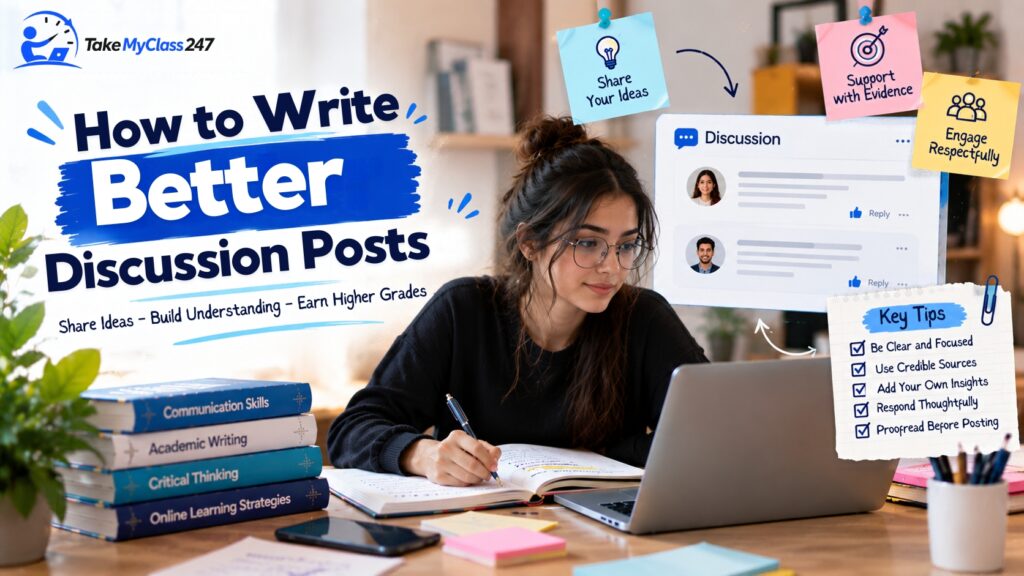
Are you unsure how to write better discussion posts? When it comes to writing discussion posts, make sure to answer the prompt directly. Specifically, your discussion should explain a clear idea with relevant evidence and engage others to respond meaningfully through thoughtful questions.
Staring at a blank discussion board and thinking about what to write there is one common experience that many students have. A discussion post may seem like an easy task, yet writing a clear, thoughtful, and effective discussion post requires much more than just meeting the word count.
A discussion post is a short written response to some questions, topics, or prompts posed by the instructor. You will often be asked to complete this assignment while taking online courses or college-level classes through learning management systems. Typically, for a discussion post writing task, depending on the subject of a particular class, you will have to explain a concept, analyze an issue, share an example, or respond to classmates.
The reason why it is essential to submit a good discussion post is that it demonstrates your comprehension of the course content as well as your ability to apply it in a certain context. Moreover, a discussion post opens the door for academic conversation. The discussion posts that are focused, evidence-based, readable, and formulated to initiate discussion among classmates are considered the best. If you wonder how to write better discussion posts, then read this blog and follow the steps recommended by academic experts.
What Makes a Discussion Post Effective?
A good discussion post does not just answer the posed question; rather, it adds an insight that moves the conversation further.
The following are some of the key characteristics of an excellent discussion post:
- Responds directly to the discussion prompt. So, do not waste too much space in the response on background information that does not help answer the question.
- Includes a well-defined central idea. Therefore, readers can clearly understand the main idea of the discussion post quickly.
- Uses shorter paragraphs that make the entire response easy to read and understand.
- Provides valid supporting evidence that makes an argument more convincing. The supporting details may be relevant course concepts, facts, examples, or appropriate personal experience.
- Maintains a respectful tone. It is good to include different opinions in academic discussions, but the disagreements presented should be respectful and constructive.
- Error-free. Generally, good grammar, spelling, punctuation, and clarity increase the readability of the discussion post.
Always remember, a good discussion post should contribute something meaningful rather than simply maintaining a required word count. Also, before submitting a discussion post, ask yourself whether your response gives readers a useful idea, example, question, or perspective to consider.
Steps to Write a Strong Discussion Post
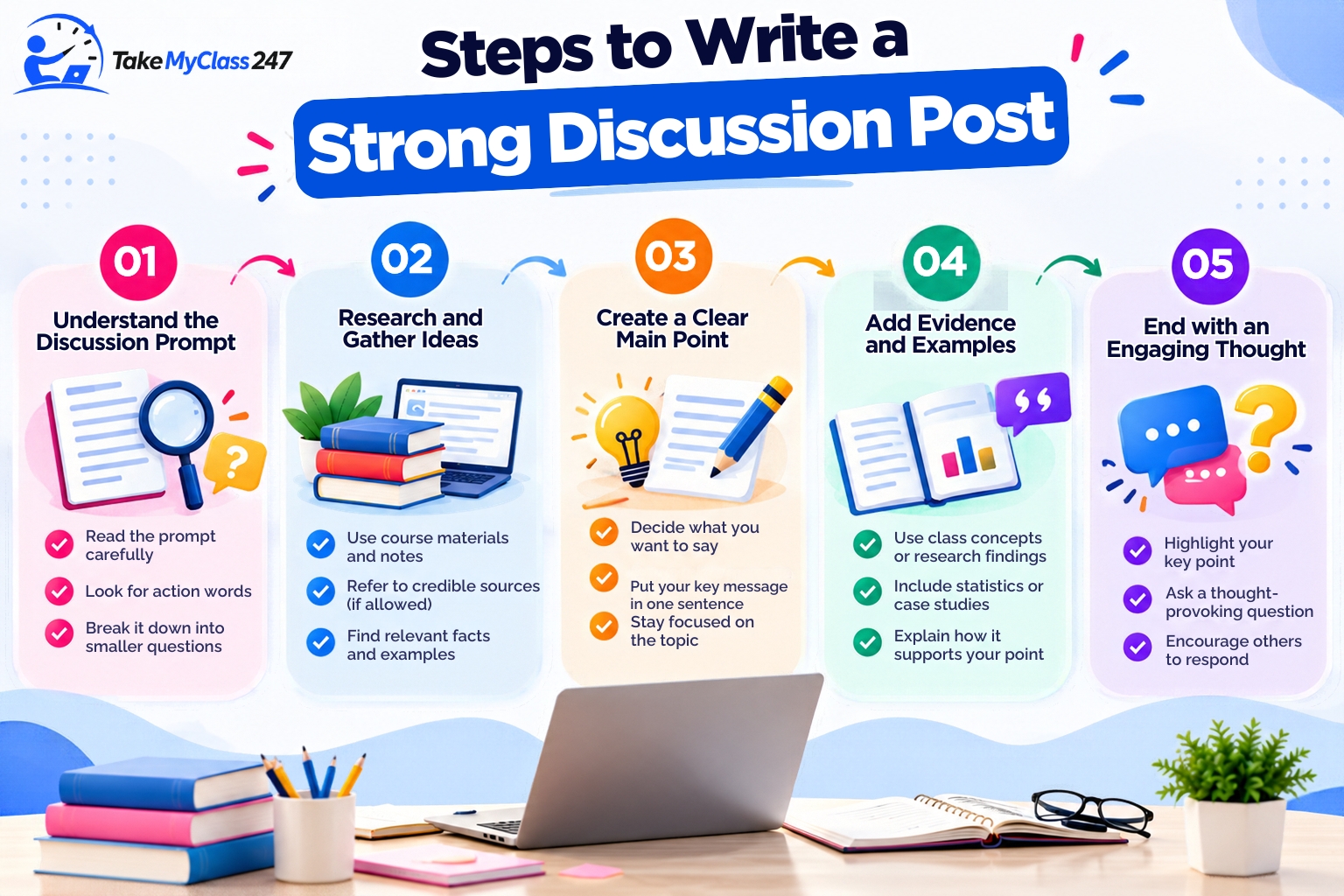
If you want to write a strong discussion post, then make sure to follow these steps
1. Understand the Discussion Prompt
Before you begin to write, read the prompt carefully. Find out exactly what your professor expects of you.
When you read the prompt, pay attention to action words, such as explain, compare, analyze, discuss, evaluate, describe, and justify. These verbs will help you identify what kind of response is required.
For instance, “Compare two theories” requires a very different approach than “explain how one theory applies to a real-world situation.”
If the prompt looks complex, break it down into smaller questions as follows:
- What topic am I discussing?
- What question should I answer?
- Do I need to give an example?
- Should I use course readings or outside research?
- Do I need to argue for anything or just explain something?
If you have a clear understanding of the discussion prompt, then you can work on the task easily and accurately.
2. Research and Gather Ideas
After that, analyze the materials related to the discussion. Focus on course readings, class notes, lectures, textbooks, and other study materials. If you have permission to include information from external sources, then make sure to refer only to credible and relevant sources.
But do not try to research all possible aspects of the topic. More information does not mean a higher-quality post. So, instead, find supporting information that is relevant to your answer.
Make sure to research and gather interesting concepts, facts, examples, or findings that help you explain your key idea. Keep in mind that conducting focused research will make it easy for you to stay on the topic.
3. Create a Clear Main Point
Before composing several paragraphs, figure out what you want the audience to comprehend.
Better try to formulate the key message in one sentence. For instance:
“Remote learning may enhance accessibility of education, but its effectiveness depends heavily on support of students and the design of the course.”
This sentence sets up the direction of your response. In the remaining part of the post, you can explain, support, or illustrate that idea.
A clear main idea helps you to keep your response from turning into a series of random thoughts. But if you have many ideas, then select the one that is closest to answering the prompt.
4. Add Evidence and Examples
Once you have your main idea, back it up with evidence.
Your evidence could be a class concept, research finding, statistic, historical example, case study, or an example from personal experience. Remember, the inclusion of personal examples will be helpful when the assignment calls for some reflection, but it must relate to the academic field. Moreover, just because you have used a quote or stated a statistic does not mean your job is done; you need to interpret it.
For example, you should not just write that “According to research, feedback makes learning better,” because it will not relate to the question at hand. Your interpretation should explain the connection between your evidence and your argument.
5. End with an Engaging Thought
Finally, finish writing your discussion post with a strong conclusion. Note that summarizing everything written in the post is not considered an effective conclusion. Therefore, in your conclusion, simply emphasize your key point and give other students a reason to respond.
One effective strategy is to pose a direct follow-up question.
Rather than asking “What do you think?” consider a more pointed question like “How would this differ if students had little access to technology?”
Usually, including a specific question will give your classmate something clear to think about. Similarly, observing and sharing thoughts from another angle will motivate your classmate to continue the discussion.
Common Discussion Post Mistakes to Avoid
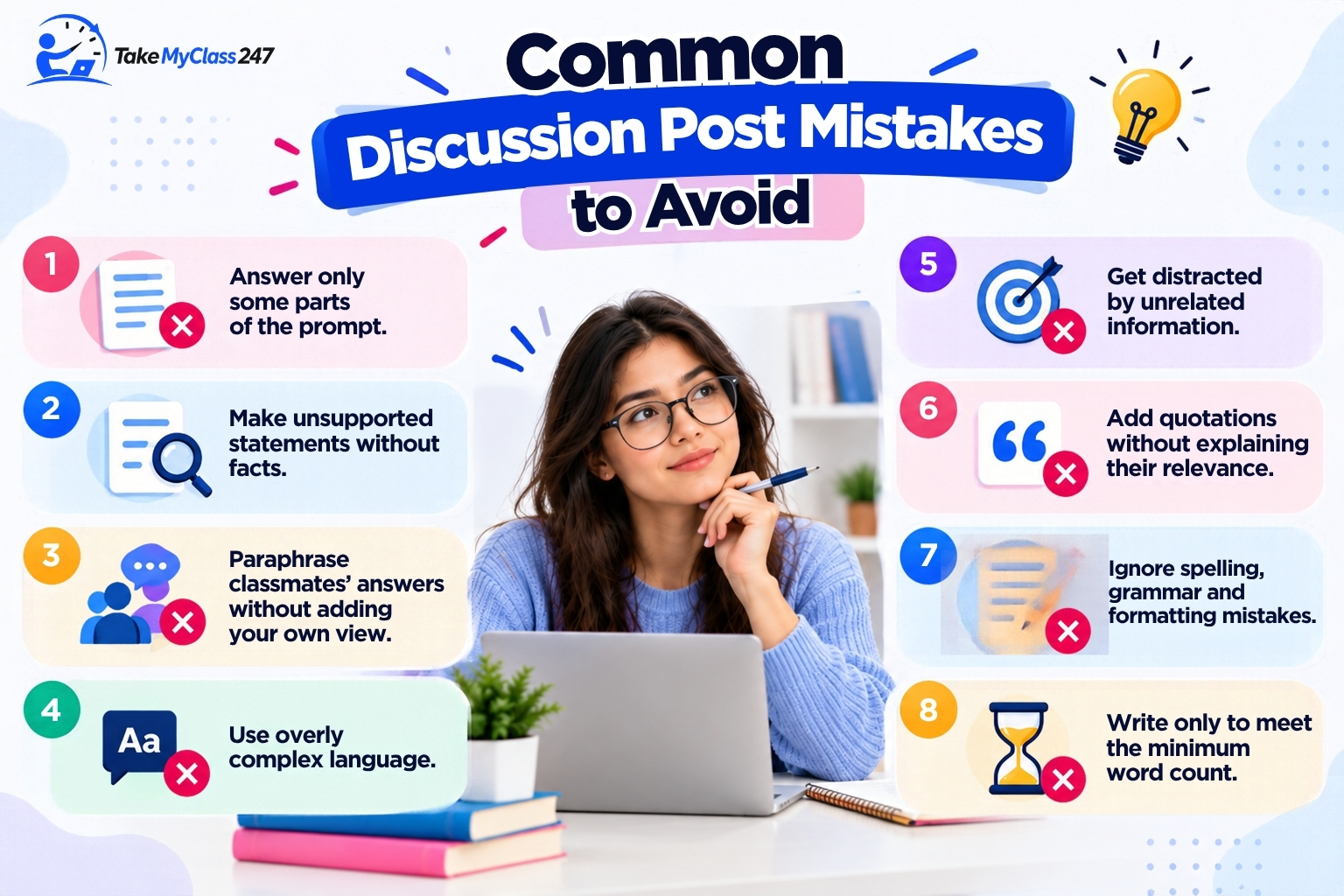
Even the best-informed answer will be less effective if the writing lacks focus. So, be aware of the common mistakes you should avoid while writing discussion posts.
Do not
- Answer only some parts of the prompt.
- Make unsupported statements without facts or explanation.
- Paraphrase your classmates’ answers without offering a different viewpoint.
- Use too complex language when a simpler one would be enough.
- Get distracted because of interesting yet unrelated information.
- Add quotations without stating their relevance.
- Ignore spelling, grammar, punctuation, and formatting mistakes.
- Write only to reach the minimum word count.
Before submission, ask yourself “Will this post provide my classmates with something to reply?” If the answer is no, write a discussion post that allows your classmates to respond with an example, explanation, connection, or thoughtful question.
How to Encourage Meaningful Discussion
Discussion boards function well if students consider them as part of a conversation rather than a collection of separate assignments.
Therefore, when you respond to your classmate, first recognize the key idea presented. Next, add your piece of information to it. Remember, you can include another example, introduce a different perspective, establish a connection to some course concept, or explain why you view the issue differently.
For example, instead of writing “I agree with your point”, specify what exactly you agree with and give the reason for it. Also, proceed with asking a follow-up question related to the argument of your classmate.
Disagreement is also a healthy component of a discussion, but it should be delivered respectfully. In case you do not agree with your classmate, remember to address the idea and not the person, and provide your arguments supported by evidence if needed.
Above all, add something to the conversation. Note that a good response should make your discussion richer, not simply add another isolated comment.
Frequently Asked Questions
What should a good discussion post include?
Your discussion post should include an answer to the prompt, a central idea, supportive details or examples, and a compelling conclusion. Overall, a good discussion post should be concise, relevant, respectful, and easy to follow.
How long should a discussion post be?
The length of a discussion post will generally vary based on the word-count requirements shared by the instructor. If no specific length is given by your instructor, fully develop your response without adding unnecessary repetition or filler.
Should I use sources in a discussion post?
You can use sources in your discussion post when your instructor requires them, or when they contribute to the explanation of the issue. But make sure your sources are relevant to the discussion topic. Also, when you use sources, follow the citation style requested by your instructor.
How can I make my discussion post more engaging?
You can make your discussion post more engaging by using relevant examples, providing explanations about your perspective, relating your ideas to the concepts covered in class, and asking thoughtful questions. In general, a focused post is more engaging than one full of general statements.
How should I respond to discussion posts of classmates?
If you want to respond to classmates’ discussion posts, acknowledge the main idea first, and then give your own contribution, such as an insight, an example, a connection, or an alternative point of view. Finally, end up with relevant follow-up questions.
Conclusion
Writing a better discussion post is more about communicating one idea clearly than using complex language. Keep in mind, a good discussion post should answer the prompt directly, make an argument, use evidence appropriately, and encourage conversation.
Especially, before you submit your discussion post, ensure you have responded to the prompt, provided an explanation for your ideas, provided evidence for your important points, and remained relevant to the topic. On the other hand, while responding to your classmates, instead of simply agreeing with them, share your insights and build on their ideas.
Initially, it might be challenging for you to create concise and thoughtful discussion posts. But once you gain some experience, the discussion post writing process will become easier. If you have any difficulties in writing better discussion posts, get online class help from experts at takemyclass247.com. They will guide you in effectively dealing with all types of assignments involved in online courses.