If you wish to secure top grades, first you must know how to study effectively for online exams. Generally, by studying early, following a realistic schedule, using active recall techniques, practicing under timed conditions, and implementing other valid learning methods, you can prepare to attend your online exams confidently.
When compared to regular classroom tests, online examinations might seem easy and convenient, but the preparation is as essential as ever. In addition to mastering the course materials, you will have to adapt to the screen-based test environment. Generally, when you take online exams, distractions at home, limited time, unfamiliar types of questions, and any other technical issues may cause difficulties for you and affect your academic performance.
For this reason, you need to make your exam preparation easier by developing a structured online exam study plan. When studying for your online exams, instead of covering the entire syllabus at once, break it down into manageable sections, practice on a regular basis, and allot some time for revision. A well-planned schedule will also provide you with ample opportunity to prepare technically for the exam. If you still have doubts about how to study effectively for online exams, then read this blog and follow the practical tips suggested by experts.
Why Are Online Exams Difficult?
Online exams can be challenging for several reasons. These are some common difficulties that make it hard for you to attend your online exams
- Large amounts of course material: You might have to revise lecture notes, reading materials, presentation slides, assignment papers, formulas, etc.
- Limited preparation time: Too many tasks or tests might leave no time to study a subject well.
- Online distractions and screen fatigue: You might get distracted, and your concentration may decrease due to notifications, social media access, usage of websites or shopping apps, and sitting for long hours in front of a screen.
- Different exam formats: You might be aware of the pattern of different types of exams, such as multiple-choice questions, short answers, essays, calculations, open-book sections, or other formats.
- Proctoring requirements: When attending proctored online exams, there might be a need for verification of your identity, access to a webcam, computer screen monitoring, specific software, or particular conditions for taking the test.
Remember, effective exam preparation is more than simply reading notes. You need to implement a study technique that enhances your subject comprehension and confidence.
10 Effective Tips for Studying for Online Exams

Are you struggling to prepare for your exams? Whenever you find it tough to study for your online exams effectively, follow these key tips recommended by academic experts at takemyclass247.com
1. Review the Exam Format and Requirements
Before studying, familiarize yourself with how the exam is going to be conducted. Find out about the type of questions, test duration, number of questions, allowed materials, submission procedure, and marking criteria.
If you know that your exam will utilize proctoring software, learn about the requirements well in advance. It will help you avoid unnecessary stress during the test.
2. Create a Study Schedule
Having a good schedule will enable you to choose what to study and when to study it. So, begin by compiling a list of all topics that can be included in the exam. Then distribute those topics throughout your available days.
Allocate more time for the harder topics rather than spending an equal amount of time on each topic. Also, dedicate some time for revisions to ensure that old topics do not get forgotten. For example, you may create a very basic schedule, like two study sessions per day and one revision of the already learned material.
3. Start Studying Early
Studying early is one of the easiest methods to increase the quality of exam preparation. Cramming before an exam might help you memorize certain information, but it will make you feel exhausted and stressed.
Instead, study for shorter periods of time throughout several days or weeks. When doing so, you will get more chances to discover your weaknesses and re-study difficult concepts.
4. Use Active Recall
Active recall refers to recalling information without referring to your notes. After you finish studying your lessons, close your book and try to explain certain concepts using your own words. Also, ask yourself questions and try answering them.
This method will be much more interesting than reading the same information multiple times. Also, it will show you what concepts you have already mastered and which ones require more effort to study.
5. Practice with Sample Questions
When you practice by using sample questions, you will get used to how the information will be tested. Also, practice questions will increase your speed and accuracy.
Once you have completed a question, review your answer carefully. Don’t worry just about the score. Figure out why you got an answer wrong and what information you lacked. Whenever there are sample tests, take advantage of them as part of your study plan. This will reduce the element of surprise during the real test over time.
6. Make Concise Study Notes
The notes that you take should make studying easier and should not give you even more material to study.
When you prepare study notes, add summaries of key ideas, definitions, formulas, dates, processes, and examples. Also, include headings, bullet points, tables, or diagrams where appropriate to make information easier to scan.
Most importantly, in your study notes, present information in language you can understand. Rewriting a textbook word for word is usually less useful than reducing a complex idea to a clear explanation.
7. Study in a Distraction-Free Environment
Your study environment may influence your concentration level significantly. Therefore, disable all distractions before you start your studies, and put your phone aside if possible.
Don’t open any unnecessary tabs on your computer, and don’t switch between studying and using social networks. If you study at home, inform other people when you want some uninterrupted time. Even a small distraction can affect your ability to go back and study a difficult topic. Usually, a quiet and organized study place will help you to have a concentrated learning session.
8. Take Regular Breaks
If you spend several hours studying without making pauses, it doesn’t always mean that you learn efficiently. In general, using screens for a long time causes tiredness, decreases attention, and strains the eyes.
While you study for online exams, take regular short breaks by standing up, drinking water, or simply turning away from the computer for a couple of minutes. After your break, come back to studying with a clear purpose. Taking breaks will enable you to maintain steady concentration rather than increasing the number of hours spent studying.
9. Practice under Exam Conditions
Once you have understood the learning material, practice as if you are actually taking the exam. While you practice, set a timer and do not consult any notes when you answer the questions.
Timed practice teaches you the pace at which you must read and respond during the real exam. This method is especially helpful if there are lots of questions or there is a deadline by which the exam must be submitted.
Once you finish your practice or mock exam, review both your answers and time management. If you have spent a lot of time on one question, then practice skipping it and returning to it later when the exam rules allow.
10. Review Mistakes before Exam Day
Errors are valuable because they show where your preparation is lacking. Therefore, make a brief list of questions or topics that you had difficulty answering during practice.
Especially during your last revision, concentrate only on these weak spots and do not revise all the material evenly. Go through the relevant concepts, do several questions on the topic, and check if you can explain the material without help. This targeted approach will make limited revision time more productive.
How to Prepare for an Online Exam the Day Before
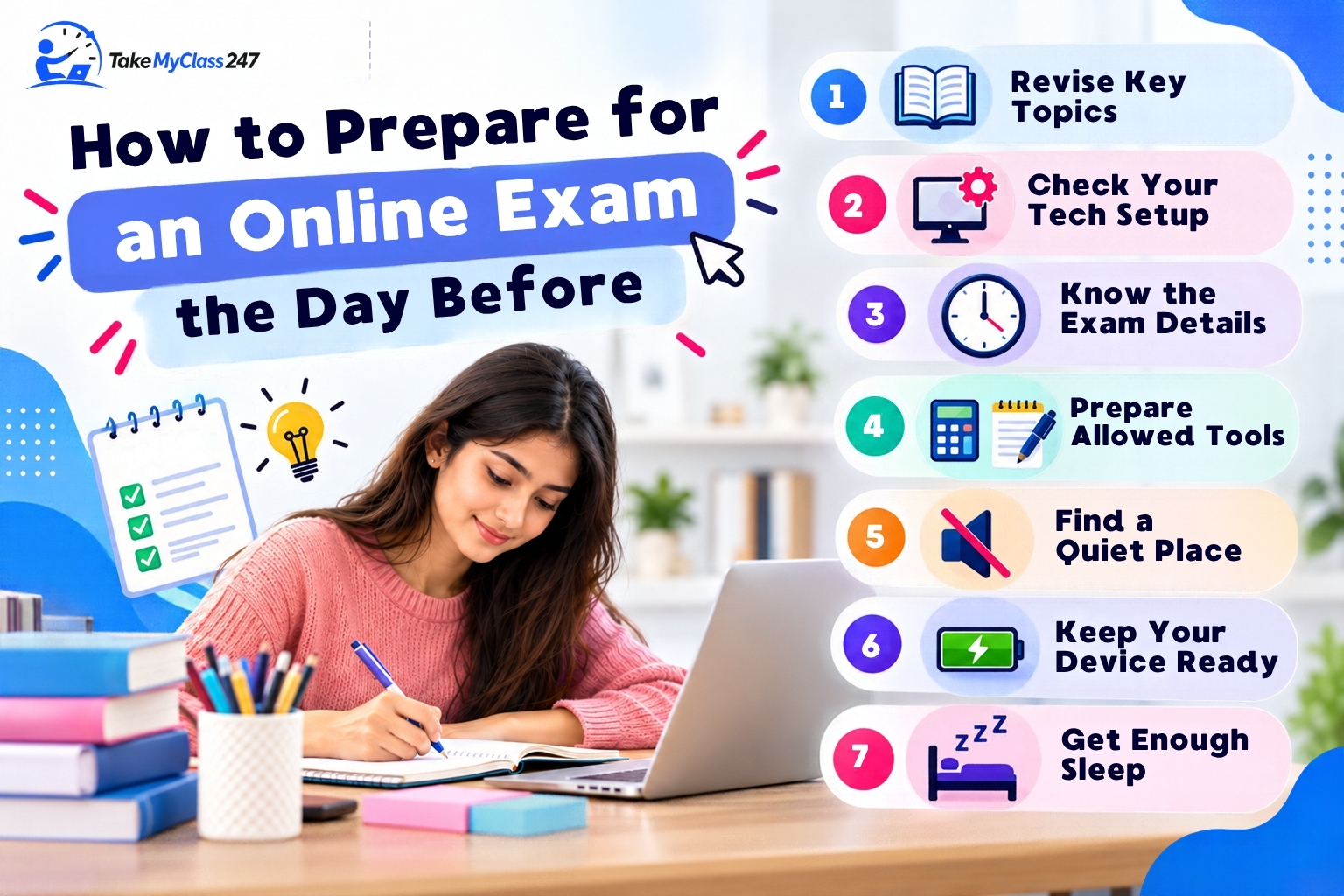
You should primarily devote the day before your online examination to boosting your confidence instead of learning an entire syllabus from scratch. Specifically, you should do the following
- Revise key concepts, formulas, definitions, and common mistakes.
- Test whether your computer, internet access, webcam, microphone, browser, and exam software work properly.
- Get a clear idea of the time of the exam, the procedure for logging in, the requirements for identification, and the procedure for submitting the exam.
- Prepare all allowed tools, such as notes, calculators, and other materials that may help you pass the test.
- Find a quiet place where you can take the online exam without any interruptions.
- Have your device charged and all necessary chargers and backup arrangements at hand.
- Get enough sleep rather than staying awake for a final cram session.
Furthermore, try not to change your routine significantly. Quiet evenings and a clear plan for exam preparation will be more valuable than several extra hours of exhausted studying.
Common Online Exam Study Mistakes to Avoid
There are some of the common practices that can decrease the efficiency of your online exam preparation:
- Last-minute cramming: Studying all material during one evening will increase your stress and decrease the level of retention.
- Passive rereading: Simply reading through the notes without testing your knowledge will lead to false understanding.
- Ignoring difficult learning material: Not studying complex topics will create significant gaps that will become problematic for you at the time of examination.
- Studying with constant distractions: Constant notifications and multitasking will distract you and reduce your focused study time.
- Not checking technical specifications: Finding out about software, browser, webcam, or internet problems shortly before an exam will create unnecessary stress at the final moment.
Better avoid all these mistakes and make sure to practice regularly, follow the active recall method, engage in focused study sessions, and conduct early technical checks.
Frequently Asked Questions
What is the best way to study for an online exam?
To study effectively for an online exam, you should be well prepared ahead of time and use various studying strategies such as active recall, practice questions, summarization of information, and timed practice. First, you should understand the exam requirements and then make a study plan that gives special attention to challenging topics.
How many hours should I study for an online exam?
The total number of hours required to study for an online exam largely depends on many factors, including the complexity of the subject, your prior knowledge in the area, the amount of information, and the available time. Several short study periods may be more effective than one long period.
How can I stay focused while studying for online exams?
Study in an area free from distractions, disable unnecessary notifications, close irrelevant tabs, and try not to have your phone near you. Also, make sure that you have set a particular goal for each study session and take regular breaks to maintain concentration.
How do I prepare for a timed online exam?
Practice answering questions in timed conditions. Find out how much time you can spend on answering each of them, without wasting time on a particularly challenging question. It will help you see where you lose time.
How can I reduce online exam stress?
Preparation is one of the best ways to decrease your stress. Study the format of the examination, practice in similar conditions, check your technology, and maintain a regular sleep schedule. During the examination, make sure you have carefully read the instructions and concentrate on one question at a time.
Conclusion
Effective studying for an online test should not be done by spending every minute available sitting in front of the computer. It should be carried out in an intelligent manner where you should plan to start early, develop an effective routine, apply active learning techniques, practice answering questions, and learn from errors.
However, at the same time, you should consider both the academic and technical aspects involved in online exams. Specifically, checking your equipment, understanding the exam platform, and preparing your study environment will help you prevent avoidable problems.
If you consistently prepare for exams and make smart use of the time you spend studying, your online exam preparation process will be more organized and efficient. Your goal should be not to simply study more, but to study in a way that helps you understand, remember, and apply what you have learned. In case you experience any difficulties in the studying process, get online exam help from experts at takemyclass247.com. They will guide you in improving your subject comprehension so that you can perform well in your exams and achieve top grades.