A good weekly schedule for online class will usually aim to balance deadlines, study times, breaks, and personal responsibilities. This, in turn, will help to create a consistent routine and minimize last-minute stress. So, when preparing a weekly schedule, it is essential to be realistic with the plan, prioritize important classes, and add buffer time.
Online courses provide convenience and flexibility. But this flexibility makes it possible for you to forget about your assignments. Moreover, when you have no proper plan, you may miss your assignment deadlines, struggle to handle multiple tasks in the same week, and also fail to utilize your study time for exam preparation. Creating a weekly schedule for online class is one of the best ways to fix this issue.
Usually, with the help of a weekly schedule, you can easily identify what task you need to perform and at what time. Instead of choosing what to do daily, the weekly schedule will enable you to plan early and provide sufficient attention to each class. Keep in mind that the weekly schedule you develop should be realistic, and it should fit around your work, family, rest, and other responsibilities. In addition, the timetable should be flexible enough to cope with unexpected tasks. If your plan is consistent, then you can reduce last-minute stress, meet deadlines more comfortably, and build better study habits.
If you are unsure how to create a weekly schedule for online classes, then read this blog and get to know the steps, tools, samples, and common mistakes to avoid.
Why Do You Need a Weekly Schedule for Online Classes?
Online students often have to deal with several types of coursework at once. Moreover, there will be different deadlines for each assignment, quiz, project, exam, and other academic activities. In such situations, a weekly schedule is much needed to bring all the commitments into one plan.
Especially, a weekly schedule will allow you to
Manage assignments, quizzes, and exams: All deadlines listed in one place will give you a better understanding of what is ahead.
Balance study with other responsibilities: You can allocate study periods depending on your work schedule, family commitments, appointments, and hobbies.
Stay organized and motivated: Dividing an extensive workload into pieces will simplify the process of handling your studies.
Proper Scheduling will also provide you with a routine. Knowing which evenings you dedicate to a certain course and which mornings to revision will make studying a routine part of your week, rather than something you keep postponing.
How to Create a Weekly Schedule for Online Class
Are you clueless about how to create a weekly schedule for an online class? If yes, then follow these practical steps and tips suggested by experts at takemyclass247.com
1. List All Your Online Class Deadlines
Firstly, gather all the data from every course. When collecting information, take into account your syllabus, learning management system, email notifications, and the course calendar.
Make sure to list all assignments, discussion topics, quizzes, exams, projects, or any other tasks you have to complete. In addition, include both due dates and estimates of the time needed to complete each of the tasks.
For instance, the task that will require 30 minutes should be planned differently than the research assignment that will require several hours.
2. Determine Your Available Study Time
Next, analyze your week and write down the time you will spend on your work, courses, meals, travel, family responsibilities, appointments, sleep, and so on.
Identify how much time you have left to study. Keep in mind that you should also consider your energy levels.
For example, if you feel tired after work, it is not likely that three hours of hard studying will bring positive results. In such instances, a shorter morning session could work better.
3. Assign Study Blocks to Each Course
Once you determine your available study hours, divide them among your courses.
Usually, subjects with a lot of assignments, complex learning material, or an approaching test may require extra time. For example, you can allocate three sessions to a challenging subject and two sessions to a course with a lighter workload.
Whenever possible, specify the aim of each study block. Rather than mentioning “study biology,” write down “read chapter 4 and answer the practice problems”. Having a specific plan will make it easier for you to start the work.
4. Prioritize Important Tasks
Not all tasks are equally important and urgent at the same time.
Therefore, begin with assignments that are both urgent and important. The task due tomorrow must be done before you start preparing for your exam due in a few weeks. But don’t neglect long-term assignments altogether. Taking little steps every day will save you from a lot of trouble in the future and avoid last-minute stress.
Here is a simple priority system you can use:
High priority: Tasks that are due soon or valuable enough to earn a good grade.
Medium priority: Important assignments due later in the week.
Low priority: Optional assignments and those with distant deadlines.
5. Set Daily Study Goals
A schedule works better when you have a specific goal for each study period.
Rather than setting a vague goal such as “work on chemistry,” aim to complete two sections of the assignment, listen to a lecture, create flashcards, or review a particular chapter.
Each time after finishing a session, evaluate what you have done. If completing a task has taken too much time, shift the unfinished work to some other appropriate moment instead of dropping the whole plan.
6. Include Breaks and Personal Time
The productive schedule is not a schedule that tries to fill all the time that you have.
Breaks give your brain some time to rest and may help you with handling longer periods of study. Hence, when you plan your weekly schedule, make sure to allot time for your meals, physical activity, recreation, social interaction, and sleep.
For longer study sessions, try taking short breaks between focused periods. Remember, a balanced approach is better than a hard-to-follow schedule that exhausts you in a couple of days.
7. Leave Extra Time for Unexpected Tasks
The online learning process doesn’t always go according to plan. The network might disconnect, the educational platform could be unavailable, or an assignment might require more time than expected.
Therefore, in your schedule, allocate some open slots during the week. They can help you cope with unforeseen circumstances.
In case no problems occur, you can use the free time to relearn complicated topics, work ahead, or relax.
8. Review and Adjust Your Schedule Weekly
Your schedule must not be set once and for all. Take a couple of minutes at the end of each week to assess what went well and what did not.
While reviewing the schedule, first take into account the upcoming deadlines, unfinished assignments, and dates of quizzes and exams. After that, make necessary adjustments to next week’s study blocks.
For instance, if some course needs to have a big project completed soon, you can add extra time to it temporarily. Similarly, if you usually finish an assignment quicker than anticipated, then change your time estimations for the future.
Sample Weekly Schedule for an Online Student
The following example will give you a clear idea about how to create a weekly schedule for online class. Remember, the timetable must be altered to fit specific commitments.
Do Course A assignment; do Course B discussion post; take a break
Wednesday
Go through lecture notes; prepare for quizzes; revise challenging topics
Thursday
Do Course A assignment; read Course C materials; take breaks
Friday
Submit the upcoming coursework; go through lessons of the week; organize notes
Saturday
Longer study block for projects; exam revision; catch-up time
Sunday
Light revision; check future deadlines; plan next week’s activities; personal time
The above schedule only comprises lectures, assignments, revision, catch-up periods, and breaks, and not hours spent studying. For easy tracking of your progress, you can divide a large task into smaller activities and allot specific time for each activity in your weekly schedule.
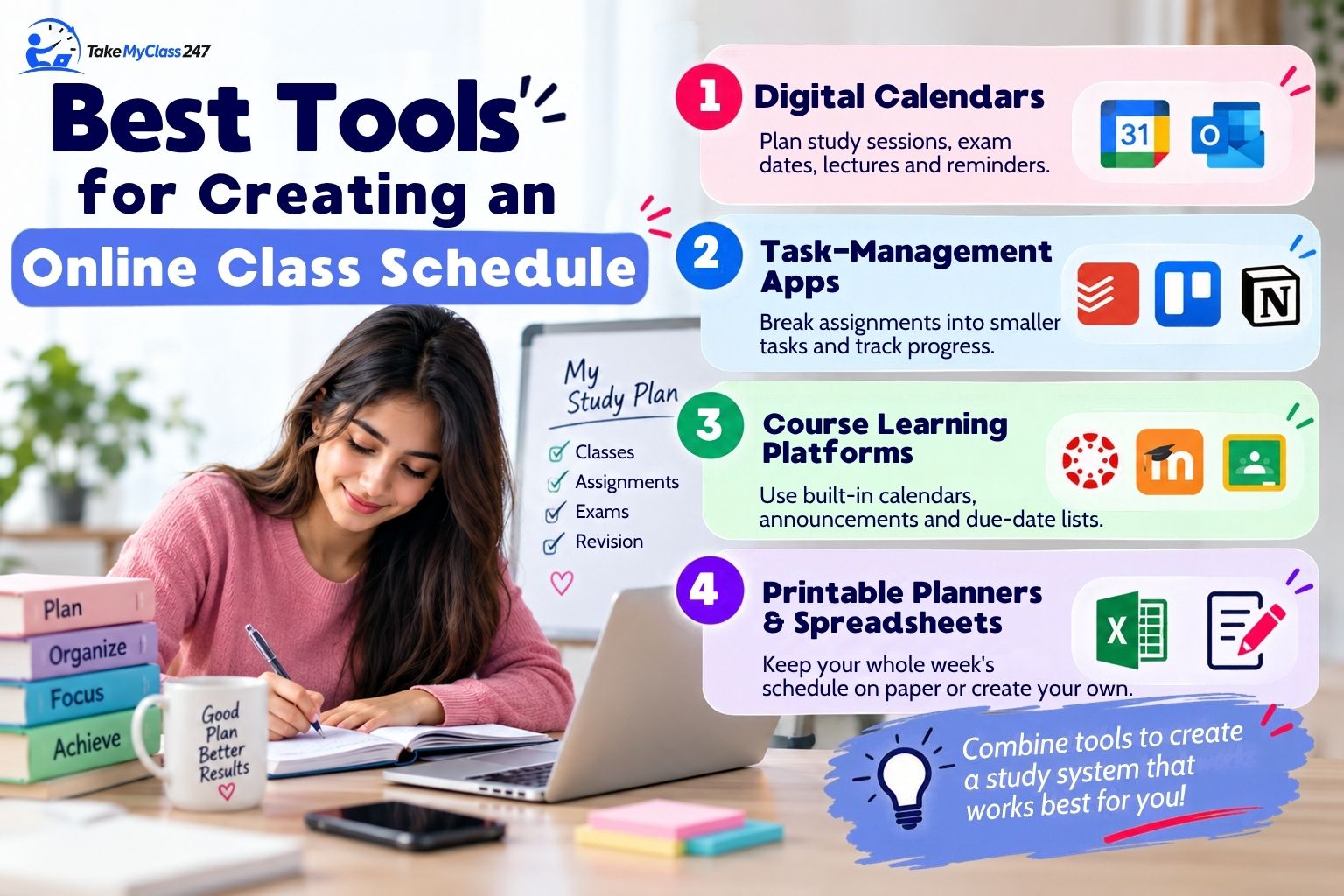
Best Tools for Creating an Online Class Schedule
You don’t have to use complex computer applications or software to keep track of your schedule for the week. In most cases, the best planner is the one that you will use all the time. Some of the best tools you can use for creating an online class schedule include
Digital calendars: They will make it easy for you to plan your study sessions, exam dates, lectures, and other reminders.
Task-management apps: With the help of task management apps, you can break large assignments into smaller tasks and monitor the progress of each task.
Course learning platforms: Almost all online course learning platforms have built-in calendars and features to notify announcements, due-date lists, or reminders. You should make sure to utilize them all.
Printable planners and spreadsheets: It is a good choice if you prefer seeing the whole week’s schedule written on paper or building your own system.
You may even combine tools and develop a schedule. For example, you can use a digital calendar for your fixed study sessions and a simple checklist for individual assignments.
Common Mistakes to Avoid When Creating a Study Schedule
Even a perfect schedule will not work if it is not realistic for your life. Here are some pitfalls to watch for:
Overloading the schedule with too many tasks: This makes the schedule simply unachievable.
Failing to consider deadlines of the assignments: Always plan backwards from your deadline, and never trust yourself to remember it.
Not building breaks into the schedule: Studying continuously can exhaust you and make you unable to concentrate.
Creating an unattainable schedule: Your schedule has to be realistic, and it should highlight your actual availability and energy levels.
Failing to adapt your schedule to changing circumstances: You might need to modify your plan depending on changes in your academic load, job responsibilities, or personal commitments.
The point of all this is not to stick to the schedule. Instead, you should use it as an effective tool that enables you to stay on track.
Frequently Asked Questions
How do I make a weekly schedule for online classes?
First, make a list of all deadlines for all courses. Next, determine when you have enough time to study and allocate time for each course depending on the amount of work and the level of difficulty. Make sure to include all daily targets, rest time, breaks, leisure, and some buffer time.
How many hours should I study online each week?
This number is not the same for every student. It will vary based on your level of courses, number of credits, their difficulty, tasks, and your existing knowledge. Hence, start with the workload that your courses require and then adjust your schedule according to your progress.
What should I include in an online class schedule?
You should add lectures, assignments, quizzes, exams, project work, revision, breaks, meals, sleep, and other fixed commitments in your weekly online class schedule. Moreover, you can also include time for reviewing course announcements and planning for next week.
What is the best schedule for online college students?
The most effective schedule should be realistic, regular, and flexible. While some students like studying in the morning, other students enjoy studying in the evening. Therefore, instead of trying to repeat somebody else’s schedule, make sure to select study periods that suit your duties and focus levels.
How can I stick to my online class schedule?
Define the goals that you want to achieve during each study session and place your schedule where it is visible to you. Begin with small portions of time instead of scheduling your whole day with studying. Also, review your schedule each week and make changes when it stops working.
Conclusion
The development of a weekly schedule for online classes is all about realistic planning, prioritization, and consistency. Simply by listing the deadlines of your academic work, defining your free time, splitting your work into smaller pieces, and setting up goals, you can easily manage your workload.
However, when creating a weekly plan, flexibility is very important too. So, give yourself some extra time for additional assignments, take breaks, and do not make it too hard for you to stick to your routine.
Most importantly, review your schedule once every week. As assignments, tests, and other personal responsibilities vary, you will need to adjust your studying schedule as well. A good weekly schedule does not serve as a strict set of regulations but rather as an effective guide that will help you make steady progress without unnecessary last-minute pressure. When it is challenging for you to adhere to your weekly study timetable, getting online class help from professionals would make it easy for you to achieve your learning goals and meet deadlines.
Was this helpful?
⏱ 10 minutes read💬 0 comments↗ 85 shares
Related Articles
How to Catch Up When You Are Behind in an Online Class
Do not quit when you cannot keep up with your online classes. If you are unsure how to catch up when you are behind in an online class, first prioritize overdue work. After that, develop a manageable schedule, study consistently, and monitor your academic progress daily. Getting behind in an online course can […]
Is Online Class Help Safe? What Students Should Know
Is online class help safe? This is a common doubt many students have in their minds. An online class help service is said to be safe only if it offers learning support, protects your privacy, uses secure payment systems, and respects academic rules. Generally, reliable services never guarantee grades or ask for passwords. […]
Are you unsure how to write better discussion posts? When it comes to writing discussion posts, make sure to answer the prompt directly. Specifically, your discussion should explain a clear idea with relevant evidence and engage others to respond meaningfully through thoughtful questions. Staring at a blank discussion board and thinking about what to […]