As a general guide, you may need about 3 hours of study time each week for every course credit. However, your study time can change based on the course difficulty, length, assignments, experience, and daily responsibilities.
“How many hours a week should I spend on an online class?” is one common question that a lot of students ask before they begin their online learning. The answer to this question usually varies according to the number of hours stated in your schedule. Typically, e-learning involves recorded lessons, reading materials, discussion postings, quizzes, projects, research papers, exams, and self-study. But in online education, the lack of actual classroom instruction can lead to underestimating the overall time required.
If you have a clear understanding of the estimated weekly workload, then it will become easy for you to develop a realistic schedule. Furthermore, you can effectively balance your online coursework with a job, family responsibilities, hobbies, and personal time.
In general, many colleges use an expectation of about three hours of academic work per credit hour per week for a standard semester course. This includes instructional tasks, learning, and doing homework. For example, a traditional three-credit course may need nearly nine hours of work per week. But this is just basic academic guidelines and not a universal rule. The total number of hours an online class requires depends entirely on your course difficulty, term length, your previous knowledge, and the amount of assigned work. To gain more insights on this topic, continue reading this blog.
How Many Hours a Week Does an Online Class Take?
For a regular 15-week, three-credit online course, an initial estimate would be 9 hours weekly. Some institutions refer to the time required as three hours per credit per week, whereas other institutions estimate the time needed based on the whole course using the total-hours method.
The key here is that credit hours are different from study hours. Credit hours indicate an academic load rather than the number of hours you spend listening to a video. According to the course, the total time might include watching videos, reading, participating in discussion forums, writing assignments, researching, doing project work, preparing for exams, and revising.
Another element that needs to be considered is the duration of the course. If a three-credit course is undertaken for eight weeks, then it might require a lot more time per week than a similar three-credit course taken in 15 weeks. The University of Wisconsin-Madison Online suggests that a total of 135 hours will be required for a three-credit course, which is equivalent to 17 hours per week if done in eight weeks.
Therefore, it is always essential to take into account the total number of hours per course and the number of weeks available for completing the coursework.
What Determines How Many Hours You Need to Study?
The total time it requires for studying an online course will typically vary based on several factors, that includes the following
1. Number of Course Credits
One of the most definitive measurements of workload is the number of credits. The workload for a one-credit course will usually be smaller than that for a 3-credit or 4-credit course.
The generally accepted standard for higher education suggests three hours per week of academic activity per credit. According to this standard:
1 credit = about 3 hours per week
2 credits = about 6 hours per week
3 credits = about 9 hours per week
4 credits = about 12 hours per week
These figures are starting points, not guarantees. Some universities use different workload calculations, so your syllabus and institution’s policies should take priority.
2. Course Difficulty
A three-credit class is not always the same as a nine-hour class.
An introductory class might include topics that are familiar to you, and therefore enable you to get through your reading and assignment work faster. However, an advanced class in mathematics, sciences, computer programming, research, or even a specific professional field might necessitate greater attention and effort.
The class may become more difficult if it includes terms that are not familiar to you or if it calls for self-study. In such cases, it makes sense to allocate additional time to study rather than trying to fit everything into a fixed weekly number.
3. Assignment and Exam Workload
The amount of work you need to complete during the week depends on your tasks.
For instance, studying a chapter and some questions will require less time compared to writing a research paper. In a similar way, a week including a quiz will not take that many hours, whereas the one with a project and an exam will take some extra hours.
So, when scheduling your week, you should consider:
Lectures and video materials
Textbook and other readings
Discussion posts and replies
Homework and writing assignments
Projects and presentations
Quizzes and exams
Research and citation work
Review and revision
Online learning requires a lot of academic effort. Hence, there is a difference in the way things are done, but the outcomes and workload associated with a class will not automatically decrease because it is being delivered online.
4. Your Learning Style and Academic Background
Two people can attend the same class and spend unequal amounts of time studying for it.
The one who understands the fundamentals will be able to progress rather fast. The other one, however, will have to put extra effort into reading, practicing, asking questions, and comprehending the material.
How you study is important too. The one who employs various methods such as active recall, questions, and repetition is likely to grasp the subject faster than the one who just rereads the same study materials again and again.
It means that the main task is not to sit at your table as much as possible, but to spend a sufficient amount of time to learn and understand the subject.
5. Your Other Responsibilities
Activities such as work, family, travel, personal care, illness, and other personal obligations could influence the amount of time spent studying.
For example, if you are employed full-time, nine hours of coursework per week could seem feasible until you take into account other duties you must perform within your household and elsewhere. Instead of cramming, determine your available time before signing up for classes.
The realistic schedule will always be more efficient than the unfeasible one that is ultimately unachievable.
How to Plan Your Weekly Study Hours for an Online Class
First, read the syllabus. After that, review the class schedule, assignment deadlines, exam dates, mandatory readings, and important projects.
Then estimate the time required for each activity. Break big assignments into smaller tasks rather than treating a whole project as one chunk of time.
Finally, set aside time to study on specific days. For instance, you can study for two hours on Mondays, Wednesdays, and Fridays, and for three hours on Saturdays.
Moreover, it is advisable to be flexible, which means that if one challenging task requires more time than you initially planned, you still have a chance to do it without disrupting your whole week.
Last but not least, adjust your schedule as the course progresses. Your first assessment serves only as a starting point, not a permanent rule.
Sample Weekly Schedule for an Online Class
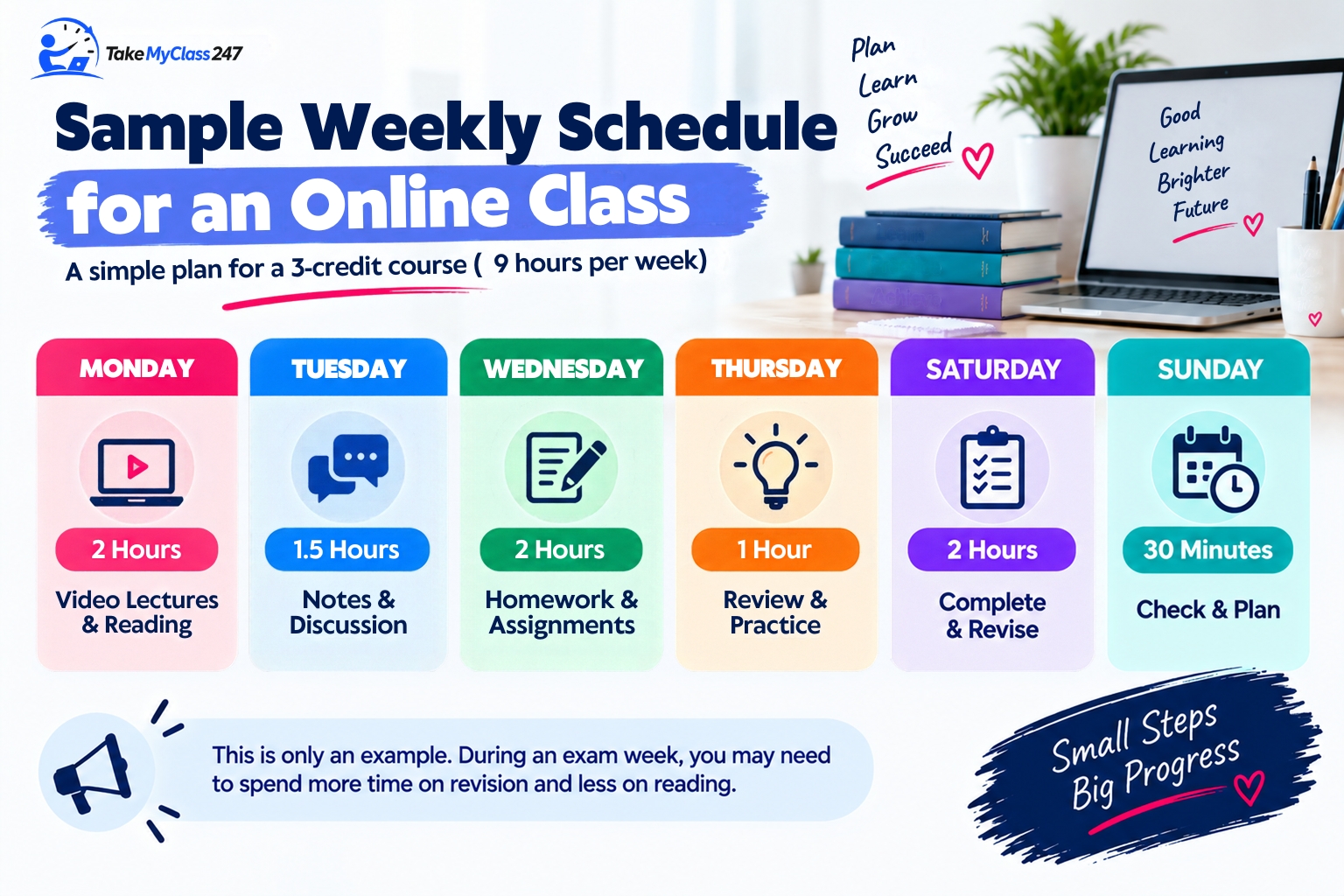
This is a sample weekly schedule for a standard three-credit course that requires roughly nine hours per week
Monday (2 hours): View video lectures and complete assigned reading.
Tuesday (1.5 hours): Study your notes and take part in discussion activities.
Wednesday (2 hours): Do your homework or weekly assignments.
Thursday (1 hour): Go through the challenging concepts and solve practice problems.
Saturday (2 hours): Complete your assignments, study for future tests, and revise everything you have studied that week.
Sunday (30 minutes optional): Make sure to check the deadlines and plan your next week.
This is only an example. But during an exam week, you will need to spend more time on revision and less on reading.
How to Know If You Are Spending Enough Time on Your Online Class
The number shown on your study timer is just one way to evaluate how much progress you are making in your online class
You probably have a good amount of time devoted to studying if you:
Keep up with readings and coursework
Submit assignments on time or ahead of schedule
Understand the important concepts of your course
Prepare well for quizzes and tests
Participate in all mandatory activities
Make consistent progress in your studies and don’t have to do a lot of last-minute work
However, frequently missing deadlines, working on assignments at the last minute, and not understanding class material might mean that you need to spend more time or change your study technique.
If you are putting in many hours studying but having trouble, the problem isn’t with your time spent. You may benefit from changing your learning strategy, seeking expert online class help from takemyclass247.com, or using academic resources.
Tips to Make Your Online Study Time More Effective
If you want to effectively utilize your online study hours, then follow these useful tips
Formulate definite study objectives. Rather than making the general statement “I will study tonight,” set an objective for what you intend to do, such as reading one chapter and answering practice questions.
Minimize distractions. Put your phone away, close unnecessary browser tabs, and find a place where you can concentrate.
Employ active learning techniques. These include answering practice questions, using flashcards, self-examination, making summaries, and explaining concepts in your own words.
Take short breaks because it will help you maintain your focus on studying during long periods of time. But avoid spending one hour of your scheduled break time scrolling through social media.
Monitor your weekly progress. At the end of every week, compare the time you planned with the time you actually needed. This will provide you with valuable data for planning the next week.
Frequently Asked Questions
How many hours a week should I spend on an online class?
For a standard semester course, you can use about three hours of academic work per credit per week as a reasonable starting point. If you’re taking a three-credit class, you may need around nine hours each week. However, you should keep in mind that your actual workload can vary depending on your course and institution.
Is an online class more time-consuming than a traditional class?
Not necessarily. You can generally expect online courses to have academic expectations similar to traditional classes. However, you may underestimate the time you need because there is less visible classroom time. You may still need to spend considerable time on reading, writing, discussions, projects, and independent study.
How many hours should I study for a 3-credit online course?
For a typical 15-week course, you can use around 9 hours per week as a useful baseline. If you’re taking an accelerated course, you may need significantly more time each week. For example, if you complete a 135-hour, three-credit workload over eight weeks, you would need to average about 17 hours per week.
Can I work full-time while taking an online class?
Yes, you can work full-time while taking an online class. To make it manageable, you will need to choose a course load that fits your schedule and plan your study time around your work and personal commitments. If you have limited free time, you may find an accelerated or heavily loaded course more difficult to manage.
How can I manage my study time for multiple online classes?
Start by calculating the expected workload for each of your classes. Then, add all your major deadlines to one calendar so you can see what’s coming up. Prioritize assignments that require more preparation time, and try not to schedule every course during the same study periods. You should also leave some buffer time in your weekly schedule to handle overlapping deadlines.
Conclusion
There is no universal answer, and weekly study time will vary greatly depending on the number of course credits, the course’s complexity and duration, the assignment load, and each student’s preparation, habits, and responsibilities.
The initial benchmark is three hours of studying per credit in a standard semester course. But the short course will require much more effort per week since the same amount of work should be done during a significantly reduced number of weeks.
The most effective strategy would be to look at your syllabus, assess your workload, plan realistic study sessions, and track your progress. If you find yourself falling behind, try studying harder or changing your study strategy. On the other hand, completing all academic tasks comfortably might indicate a successful schedule.
In any case, succeeding in your online classes will be less about how much time is spent on studies and more about dedicating sufficient attention to your coursework. When it is challenging for you to manage your weekly schedule or struggles to complete any assignments involved in your course, taking customized academic guidance from subject experts at takemyclass247.com would provide you with numerous benefits.
Was this helpful?
⏱ 10 minutes read💬 0 comments↗ 100 shares
Related Articles
How to Catch Up When You Are Behind in an Online Class
Do not quit when you cannot keep up with your online classes. If you are unsure how to catch up when you are behind in an online class, first prioritize overdue work. After that, develop a manageable schedule, study consistently, and monitor your academic progress daily. Getting behind in an online course can […]
Is Online Class Help Safe? What Students Should Know
Is online class help safe? This is a common doubt many students have in their minds. An online class help service is said to be safe only if it offers learning support, protects your privacy, uses secure payment systems, and respects academic rules. Generally, reliable services never guarantee grades or ask for passwords. […]
Are you unsure how to write better discussion posts? When it comes to writing discussion posts, make sure to answer the prompt directly. Specifically, your discussion should explain a clear idea with relevant evidence and engage others to respond meaningfully through thoughtful questions. Staring at a blank discussion board and thinking about what to […]