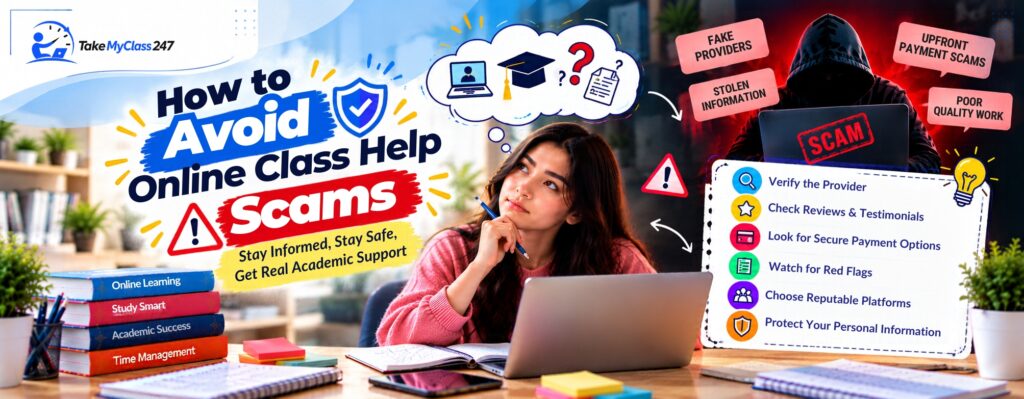
You must know how to avoid online class help scams to get rid of certain risks. Before you use any online class help services, carefully research the provider, verify their reviews and tutor qualifications, understand their payment and privacy policies, and also ignore unrealistic guarantees.
In recent years, students have often been searching for online tutoring, homework help, study tips, etc for various reasons. Hence, online academic support services are becoming more popular. However, in certain scenarios, especially when a service provider offers high-quality educational assistance, their services become highly beneficial. On the other hand, some fraudsters try to benefit from the growing popularity.
Generally, online classes help scams involve financial fraud, identity theft, false service descriptions, fake reviews, or unrealistic promises. So, the chances are high that students may easily fall into such traps when they experience a last-minute need to complete a certain assignment.
Fortunately, by performing multiple checks, you can reduce the risk involved in choosing a fraudulent online class help service. You can also avoid fraudsters by researching a provider, understanding its policies, protecting account information, and using secure payment methods. To learn further about how to avoid online class help scams, read this blog and follow the practical tips recommended by academic experts.
What Are Online Class Help Scams?
An online class help scam is an illegal activity whereby a service provider claims to offer academic assistance but fails to provide the required service. At times, such a provider takes money and runs away, and in some cases, provides low-quality services and asks for further money. There is also a case where a provider uses a student’s personal and academic information for other fraudulent purposes.
Some of the strategies used by fraudulent providers to attract the attention of students include offering discounts, making urgent offers, posting influential messages on social media sites, sending unsolicited emails, or setting up web pages that make impressive claims with no verifiable information whatsoever.
The main difference between an online academic help scam and a legitimate academic support service is transparency. Usually, a reliable online class help service provider clearly explains the services they offer, the costs of their services, how they handle their customer information, and what will happen in case they fail to provide the service.
Furthermore, learners need to understand that legitimate academic assistance does not always mean writing assessed work on behalf of a student. Tutoring, explanation, proofreading in cases where it is allowed, study tips, and learning help are usually different from assistance intended to get around academic policies.
Why Do Students Fall for Online Class Help Scams?
There are various reasons why students become vulnerable to online class help scams. Some of them include
- Urgent Assignment Deadlines: When there is only an hour left before the deadline, students tend to act spontaneously and without prior research about the provider.
- Low-Cost Service Offers: Extremely low prices can tempt students who deal with tight budgets.
- Lack of Provider Research: Having an impressive website does not necessarily mean that the company is reliable.
- Guaranteed Grades and Results: Promises of high grades and guaranteed results seem tempting, but usually they turn out to be unattainable.
- Limited Awareness of Online Fraud: Students who are not aware of common digital scams may overlook warning signs of online class help scams.
12 Tips to Avoid Online Class Help Scams
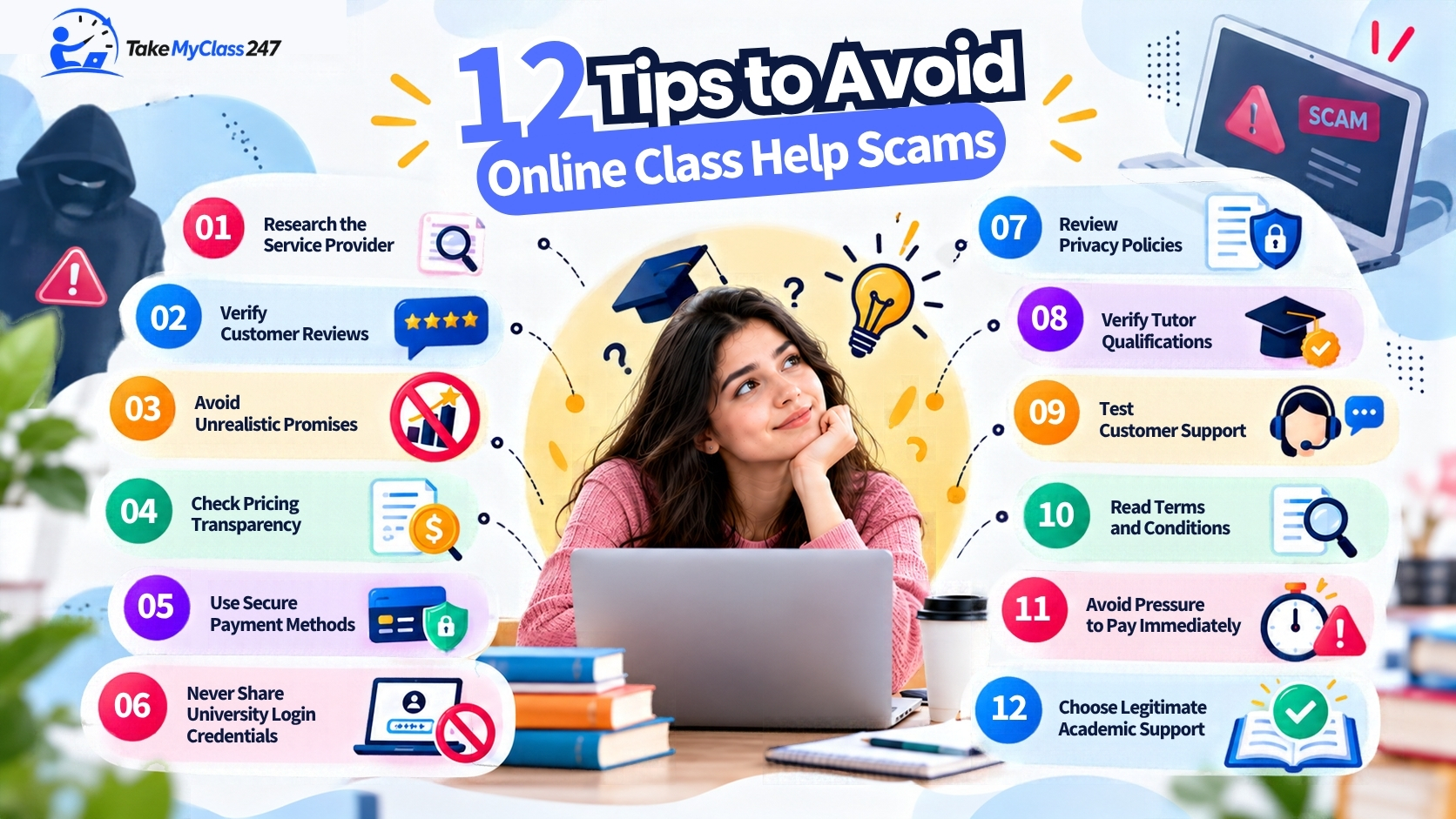
Do you wonder how to avoid online class help scams? If yes, then follow these practical tips suggested by professionals at takemyclass247.com
1. Research the Service Provider
Begin by investigating the business background, contact, experience, and reputation of the provider. Do not stick to the information presented only on the company’s website. Make sure to look for additional information about the service provider from other sources.
2. Verify Customer Reviews
Do not trust customer reviews that are present on the company’s website only. Pay attention to detailed customer experiences that can be found in different independent sources. Beware of repeated, vague, and too similar reviews.
3. Avoid Unrealistic Promises
Do not fall for guarantees of grades, excellent marks, quick completion, and other similar unreasonable promises. In general, achieving success in academics requires certain things and cannot generally be guaranteed by third parties.
4. Check Pricing Transparency
Before you pay for a service, get to know the full cost, which includes taxes, revision fees, cancellation charges, deadlines, and refunds. If any of these costs are hidden until you pay, then think twice about making such a transaction.
5. Use Secure Payment Methods
Make sure to use only a secure payment system that provides a transaction record and, if necessary, a way to dispute the transaction. Most importantly, be careful when someone asks you to pay via non-traditional methods, using private accounts, cryptocurrency, or gift cards without proper explanation.
6. Never Share University Login Credentials
Do not share your password, authorization code, or other details related to your login to your university account with service providers. It will give them the right to access your university account and see all your personal information, academic records, and private communications.
7. Review Privacy Policies
Study the privacy policies of the service provider before uploading any of your assignment requirements, identification documents, or other personal data. Also, you need to know what personal data the provider collects, for what purpose, how long they will store that data, and whether they will transfer it to third parties or not.
8. Verify Tutor Qualifications
If the company provides online tutoring services, then verify whether the tutors on its team are academically and professionally qualified. Furthermore, the provider should be ready to discuss the process of selecting tutors without making any unverifiable claims.
9. Test Customer Support
Pose a simple question before paying for the service and see if the customer support representative replies clearly and professionally. Poor communication at the beginning can only worsen after payment.
10. Read Terms and Conditions
Usually, terms and conditions will contain valuable information regarding refunds, cancellations, revisions, delivery, privacy, and other aspects of a service. Do not ignore reading them just because you are on a tight schedule.
11. Avoid Pressure to Pay Immediately
Scammers may try to put pressure on you by stating that the offer only lasts for several minutes or that it is necessary to make an instant payment to get help. Therefore, spend some time researching the company before making any payments.
12. Choose Legitimate Academic Support
When you look for academic assistance, give preference to services that focus on tutoring, providing explanations, improving study skills, offering feedback, or other forms of learning support that comply with your institution’s academic integrity policies.
Common Warning Signs of Online Class Help Scams
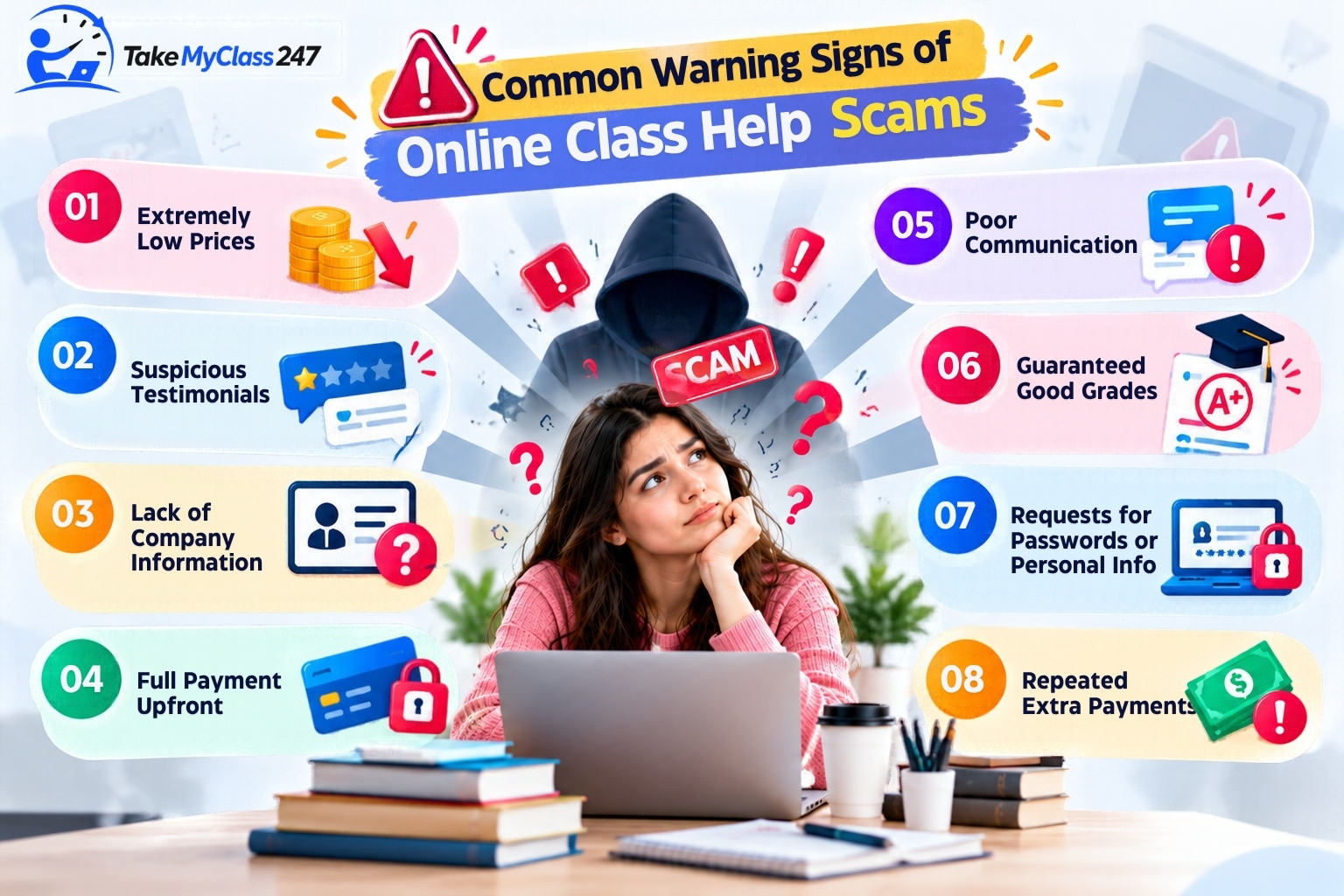
Before you avail an online class help service, watch out for a combination of the following warning signs:
- Extremely low prices without any explanation.
- Unreliable or suspicious testimonials.
- Lack of information about the company’s identity and/or contact details.
- Asking for full payment without explaining the terms.
- Poor and irregular communication.
- Guarantees of good grades or results.
- Requests for passwords, authentication codes, or excessive personal information.
- Asking repeatedly for extra payments after initial payment.
One red flag doesn’t automatically mean that the online class help service is a scam, but the presence of multiple ones suggests you should do more research before you avail the service.
How to Verify Whether an Online Class Help Service Is Legitimate
Before you get online class help services from a company, verify their contact details and business information. Also, search for its history and customer experiences that are not provided on the official website of the service provider.
Next, compare the terms for refunds, privacy, cancellation, and payments of the provider against those of other similar and reputable providers. Also, make sure that you get all the information about the service you are buying.
Lastly, consider whether other independent sources have provided consistent information regarding the provider. A good-looking website, professional logo, and many testimonials alone do not constitute evidence of legitimacy.
What to Do If You Have Been Scammed
In case you feel you have been a victim of an online scam, do the following:
- Stop Further Payments: Do not make any more payments, even if the service provider claims that you are supposed to make further payments.
- Save Messages and Payment Records: Keep all the emails, online chats, invoices, receipts, transaction records, etc. safe.
- Contact Your Payment Provider: Check whether your payment can be challenged, cancelled, or somehow investigated.
- Change Compromised Passwords: If you have shared credentials, then immediately change your passwords and secure related accounts.
- Report Suspicious Activity: Make a report about this situation through proper fraud and consumer protection services.
- Seek Appropriate Consumer or Institutional Support: In case the scam was related to academic credentials or university accounts, quickly contact the relevant university office or support team.
How to Protect Your Academic Information Online
Always have strong and unique passwords for your important accounts and use multi-factor authentication where available. Do not give your login details to external vendors at any time.
Furthermore, make sure to remove unnecessary personal information from the document prior to uploading it. This means you should not include any student ID numbers, addresses, phone numbers, or other personal data unless necessary.
Lastly, always utilize secure communication and payment methods. Also, be careful about clicking suspicious links or downloading unexpected files.
Frequently Asked Questions
How can I identify an online class help scam?
You can find out an online class help scam by conducting independent research on the service provider, checking their customer reviews, verifying business information, analyzing pricing and refund policies, and noting unrealistic promises or requests for sensitive information.
What are the biggest warning signs of an academic support scam?
Some typical warning signs of an academic help scam are promised grades, unrealistically low prices, not clear business details, testimonials that are questionable or fake, urgency for immediate payment, bad communication, and requests for personal passwords or extra money.
Is it safe to pay for online class help services?
Yes, it is safer when the online class help service provider is open about its identification, cost, privacy policy, terms and conditions, and refund policy. But you must first research the service before you make payment.
Should I share my university login details with a service provider?
No, you must not share your University passwords, authentication codes, and account credentials. In general, sharing these details can put your academic records and other personal details at risk.
What should I do if an online class help company takes my money?
Stop further payments, save all evidence of transactions and communication, contact your payment processor, lock down any accounts that have been compromised, and file a complaint through proper consumer or institutional channels.
Conclusion
The process of avoiding online class help scams begins with taking some time to analyze everything. So, before you approach a service provider for academic support, make sure to find out about the company, check its reviews, and pay attention to prices and refund policies. Most importantly, don’t buy into promises that sound too good to be true. Also, try to protect your academic credentials and reduce the amount of personal information you post online.
Whenever you need professional help with online classes, look for companies that are clear about their services and meet all the academic integrity standards. In general, conducting fundamental research before paying for a service will help you prevent financial loss, privacy problems, and unnecessary stress later. If you require reliable online class help services, then you may approach takemyclass247.com that has a dedicated team of experts on diverse subjects to provide customized academic support.