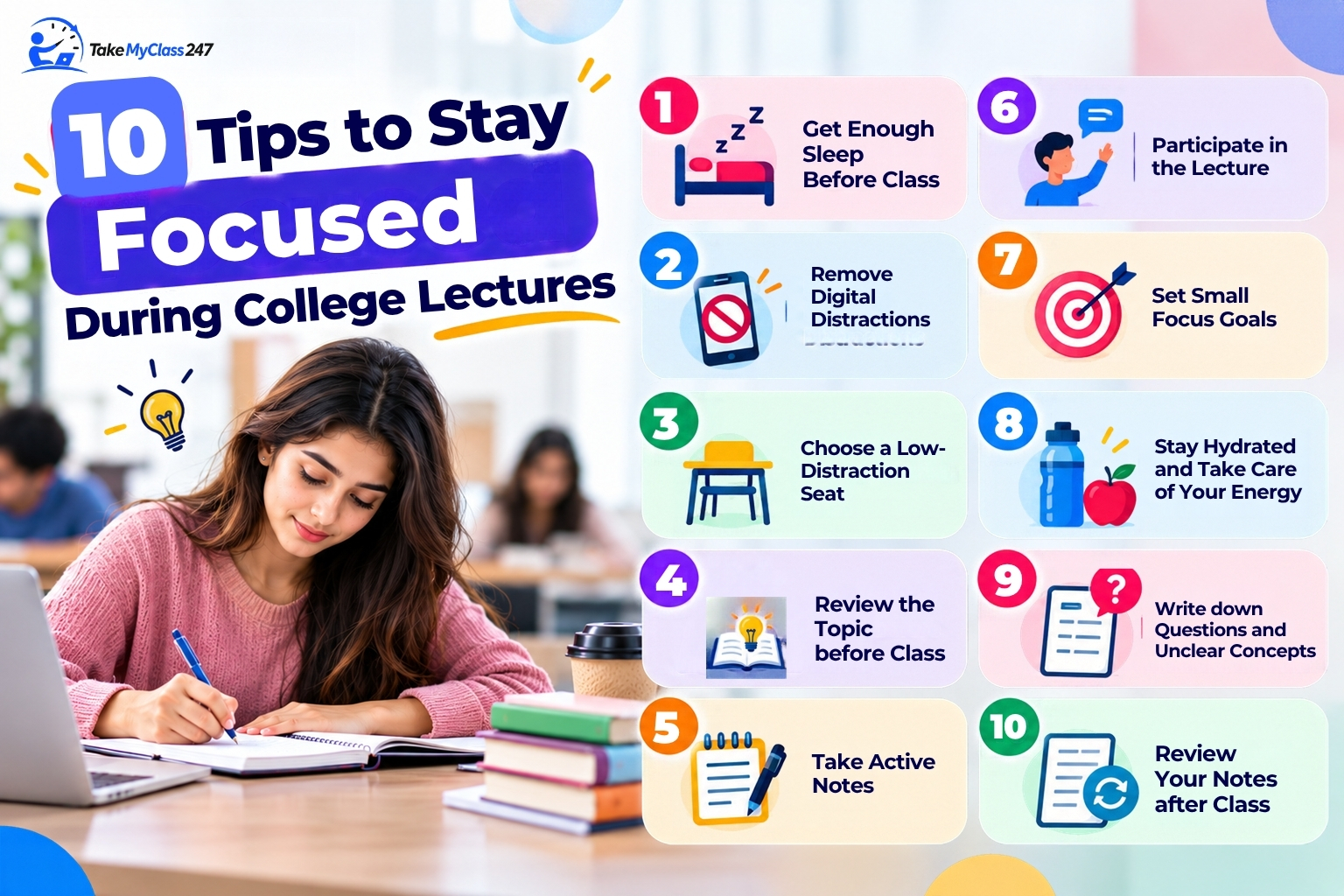
If you have no idea how to stay focused during college lectures, first prepare yourself before class by getting enough sleep. Then, while you attend your class, take notes and participate in classroom tasks and discussions actively. Also, try to avoid distractions by keeping your phone switched off and not engaging in multitasking.
It might look easy for you to stay focused throughout your college lecture, but in practice it can prove to be very challenging. For instance, a notification sound coming from a cell phone, lack of night sleep, a lengthy lecture, and the anxiety related to an upcoming task can all easily distract your attention. Sometimes even when you want to listen, your mind may wander.
Attention is the basis for effective learning. So, it is essential to stay focused. While being attentive, you can grasp the explanation and its key points, take notes, and memorize all of the needed information. Furthermore, research by the American Psychological Association states that distractions and mind wandering are barriers to the learning process, and they may interfere with memory.
Concentration does not rely solely on the personal ability to pay attention. You can enhance your focus through some useful practices like preparing before class time, avoiding distractions, taking notes, participating actively, and reviewing after class. If you want to know more about how to stay focused during college lectures, read this blog and follow the practical tips recommended by academic experts.
Why is it hard to Stay Focused during College Lectures?
These are some common reasons that can make it challenging for you to stay focused during college lectures
Phone and social media distractions: Your smartphone gives you constant access to messages, social network updates, videos, and other notifications. Even a glance at your smartphone can distract you from paying attention and following the lecture. Also, technology-related distractions have been found to negatively impact your ability to retain and understand information in the lecture.
Long or information-heavy lectures: In some cases, you might need to process an enormous amount of information provided in one lecture. During such situations, it can be tough for you to maintain attention and process every detail.
Lack of sleep and low energy: Your sleeping habits might affect the amount of attention you have to concentrate on lectures. When you are sleepy, you will find it difficult to pay enough attention to explanations provided in class. Research has found that a lack of sleep might result in impaired attention and other cognitive activities.
Stress and distractions: Usually, when you think about something else, such as assignments, tests, jobs, relationships, money issues, and other responsibilities during your lecture, it can become harder for you to pay full attention to what your instructor says.
Passive listening habits: If you just sit and listen to lectures without paying any attention and processing the information, you may lose concentration very quickly. However, active engagement will give your brain a reason to keep processing what the instructor is saying.
10 Tips to Stay Focused During College Lectures
If you often get distracted during your classes, it might become tough for you to improve your subject comprehension and academic performance. But following these tips suggested by experts at takemyclass247.com would enable you to stay focused throughout your lectures
1. Get Enough Sleep Before Class
Attend your lecture after getting enough rest and when you are mentally alert. In general, staying awake till late hours to complete your work can seem more productive, but being exhausted will make it difficult for you to comprehend new information.
So, whenever possible, try to follow a routine sleep pattern and never make late-night studying a regular habit. A well-rested mind will be ready to listen, make connections, and actively participate.
2. Remove Digital Distractions
Turn off notifications before attending lectures. Ensure your cell phone is silent or put it in a place where you cannot access it easily if it rings.
In case you decide to use a computer or a tablet for taking notes, close all social media apps, shopping websites, and other unnecessary tabs in the browser. Technology will not only help you learn but also distract your attention.
3. Choose a Low-Distraction Seat
Your choice of seat may affect your ability to concentrate. Therefore, pick a spot where you can see the instructor, presentation, or board and hear the lecture well.
If possible, try not to choose areas where you might engage in conversation with your friends or be distracted by people who move around. There is no need to sit in the front row of the classroom. The best seat is the one that helps you stay involved.
4. Review the Topic before Class
Spend a few minutes reviewing your assigned reading material, slides, or your notes. Remember, you are not required to master the material ahead of time.
Rather, try to identify important vocabulary, concepts, and questions. Knowing something about the topic helps you understand the lecture better. According to research, answering questions before learning the material might be helpful at times to enhance subject knowledge and academic performance.
5. Take Active Notes
You do not need to write down everything the instructor says. Just jot down the main concepts, examples, explanations, definitions, questions, and connections.
Active note-taking keeps you engaged in the decision-making process. Also, it will provide you with something valuable to study later. Research on note-taking has shown that how students process the information is much more significant than merely transcribing the lecture.
For example, instead of writing, “photosynthesis transforms light energy to chemical energy”.
You can note down hints like
Photosynthesis → light energy → chemical energy.
Why is chlorophyll necessary?
Go through the steps after class.
This approach will give you information along with the questions or prompts for further study.
6. Participate in the Lecture
Ask questions, respond to questions, engage in discussion, or think about explaining the idea in your own words.
When you participate, your position transforms from that of a passive participant to that of an active participant. It is not necessary to speak out loud; you can remain involved by asking yourself “why is this relevant?” or “how is this related to what I learned last week?”
7. Set Small Focus Goals
Rather than saying, “I must maintain my focus through the whole two-hour lecture,” break the session into smaller targets. For instance, plan to concentrate till the next topic, example, or section. Then concentrate again and keep doing it.
Small goals can make the whole process easier for you. Furthermore, structured chunks will allow you to stay concentrated, especially in the case of online learning.
8. Stay Hydrated and Take Care of Your Energy
Simple physiological needs can impact your state of alertness and comfort. Carry water when necessary, eat balanced meals, and try to not rely much on excessive caffeine to compensate for poor sleep.
Following a healthy routine will not guarantee that all lectures are going to be enjoyable, but at least it will eliminate some physical obstacles that prevent you from concentrating.
9. Write down Questions and Unclear Concepts
In case you are unable to understand a concept, mark it rather than getting mentally blocked by it.
Take notes such as “need to revise formula,” “find out reason,” or “ask about example 2”. Then return your attention to the current part of the lecture. Do not let one confusing point distract you from the next ten minutes of the lecture.
10. Review Your Notes after Class
Take some time to check your notes while the lecture is fresh in your mind. Complete the incomplete points in your notes and also answer any queries and pinpoint topics you require extra work on.
This will turn your notes into a learning guide rather than just a piece of information you leave alone until exam time arrives. Effective learning usually depends on how students utilize the information after class.
How to Stay Focused During Online College Lectures
Online lectures can bring about a wide range of distractions, as there is a chance of having fun, receiving messages, doing household chores, and other activities within the same learning environment. So, you should follow a disciplined routine to stay focused and avoid distractions.
Set up an isolated area for studying whenever possible. As soon as you start the lecture, close all other unnecessary tabs and applications on your phone and laptop. You could use the fullscreen option if it assists in avoiding visual distractions.
Most importantly, do not multitask. Although watching a lecture and, at the same time, answering your messages or visiting other websites may seem productive, splitting your attention reduces your ability to comprehend the information shared by lecturers.
In the case of long sessions, it is advisable to take short breaks if the format of the lecture provides for that. Studies that are related to video-recorded lectures also suggest that activities like intermittent testing can support attention and learning.
What to Do When You Lose Focus during a Lecture
It is natural to lose focus while attending a lecture. But what matters is how fast you manage to get back on track.
First, concentrate on what the teacher is saying now instead of what has been missed before. Then make yourself a note or ask a question regarding the ongoing discussion. This will give you something specific to focus on.
Also, get rid of the immediate distractions. Put away your mobile phone, close an unrelated tab in your browser, or stop paying attention to the surrounding conversation.
Later, during revision, try to fill in the gaps in your knowledge by reading the part of the material you missed during the lecture. Never think that you have spoiled your whole lesson because you got distracted for a few minutes. Refocusing is a skill that becomes easier with practice.
Common Mistakes That Reduce Lecture Concentration
These are some habits that can disrupt your concentration while you attend college lectures
Using your mobile phone during lecture sessions can distract your attention
Lack of preparation can make it hard for you to understand new concepts.
Multitasking can split your concentration among different tasks.
Staying up late ahead of lectures can make you feel mentally fatigued.
Just passively taking down notes can prevent you from understanding the concepts explained by your professor.
Avoiding these mistakes can increase your focus on the lectures. Specifically, you should listen actively, take notes, and control distractions consciously.
Frequently Asked Questions
How can I focus better during college lectures?
Be well-prepared for the lecture, get enough sleep, minimize use of your phone or web browsers, select a suitable seat, and take notes. Most importantly, make sure you have a task to complete with what you hear, like formulating concepts and asking questions.
Why do I lose focus during lectures?
Lack of energy, stress, digital distractions, information overload, boredom, and passive listening are the key causes that can make you lose your concentration during lectures. Sometimes even your learning environment becomes a reason for losing your focus.
How can I stay focused during long lectures?
When attending long lectures, first divide the session into smaller parts mentally. After that, make brief focus targets, take productive notes, participate whenever you can, and jot down your queries instead of getting distracted by them.
How do I stay focused during online college lectures?
If you want to be attentive during online classes, set up a distraction-free, dedicated space for studying, use full-screen mode, close all unwanted tabs in the browser, turn off phone notifications, and try not to multitask. During longer sessions, you can take short breaks if allowed.
What is the best way to take notes during a lecture?
There is no specific technique that suits everybody and fits all subjects well. During the note-taking process, concentrate on comprehending the subject and record key points instead of simply writing everything down. Also, in your notes, make sure to add important examples, explanations, questions, and topics that require later review.
Conclusion
Focusing in class lectures isn’t just about forcing you to concentrate; it is also about creating an environment where concentration is easier.
If you want to stay focused during college lectures, prepare before class, get adequate sleep, limit digital distractions, sit in an area with minimal disturbances, and participate actively. Especially while you listen to lectures, take down notes, raise questions, and have small goals to achieve whenever you feel your mind is wandering away. After the lecture, review your notes while the knowledge is still fresh in your mind.
It is absolutely normal to lose focus. But what matters the most is developing consistent habits to recognize distraction, regain concentration, and keep on learning. These small habits may become very helpful in making your lectures more understandable and productive. If it is challenging for you to understand your course materials, taking online class help from subject experts at takemyclass247.com would benefit you in improving your comprehension and excelling in your studies.
Was this helpful?
⏱ 10 minutes read💬 0 comments↗ 91 shares
Related Articles
Canvas vs. Blackboard vs. Moodle: Which LMS Is Best for Online Students?
Canvas, Blackboard, and Moodle are popular learning management systems that support online coursework. If you want to know which LMS is the best for online students, make sure to compare each platform’s interface design, course organization, customization, and other specific features configured by institutions. Canvas, Blackboard, and Moodle are the three learning management […]
You must know how to avoid online class help scams to get rid of certain risks. Before you use any online class help services, carefully research the provider, verify their reviews and tutor qualifications, understand their payment and privacy policies, and also ignore unrealistic guarantees. In recent years, students have often been searching […]
How to Catch Up When You Are Behind in an Online Class
Do not quit when you cannot keep up with your online classes. If you are unsure how to catch up when you are behind in an online class, first prioritize overdue work. After that, develop a manageable schedule, study consistently, and monitor your academic progress daily. Getting behind in an online course can […]