If you know how to study while taking multiple online courses, you can succeed easily. Usually, prioritizing tasks, creating a clear plan, using active study methods, reviewing your weekly progress, and following other practical tips will help you to balance several classes and maintain consistent performance.
Trying to manage several online classes at once might feel like having too many tabs open in your browser. Usually, for each course, you might have to deal with different learning materials, lectures, tasks, quizzes, discussion boards, and tests. So, when the deadlines start overlapping, it can be difficult for you to complete your work, even if you are highly motivated. However, you can handle multiple online courses effectively without waking up early. Furthermore, following a systematic approach that involves organization, prioritization, and consistent study habits will help you identify what is to be done and when.
Usually, online learning will enable you to use convenient study hours, but that flexibility may become a problem for you if you don’t have a proper plan. This is the reason why several University learning centers recommend that students adhere to a schedule, estimate the workload, and review the course requirements rather than depending on the assignment deadlines. If you are still unaware of how to study when you have multiple online courses, follow the practical tips recommended by academic experts in this blog.
Why Is It Difficult to Study for Multiple Online Courses?
These are some common challenges that can make it hard for you to cope with multiple online classes and an academic workload
Overlapping deadlines: There can be two or more assignments, quizzes, or tests to do in the same period. If you wait till the deadline is near, the workload will grow very fast.
Different course requirements: Some courses can involve weekly quizzes, while others can deal with various academic papers, projects, problems, and discussions. So, you need to invest more energy and time in switching between academic tasks of different types.
Large amounts of reading and coursework: Online courses can involve lectures, textbooks, articles, videos, practice activities, and independent research. All this workload can be underestimated easily.
Difficulty staying organized and motivated: It might become harder to stay organized and motivated without face-to-face classes. Therefore, even minor delays may turn into a huge pile of tasks to do.
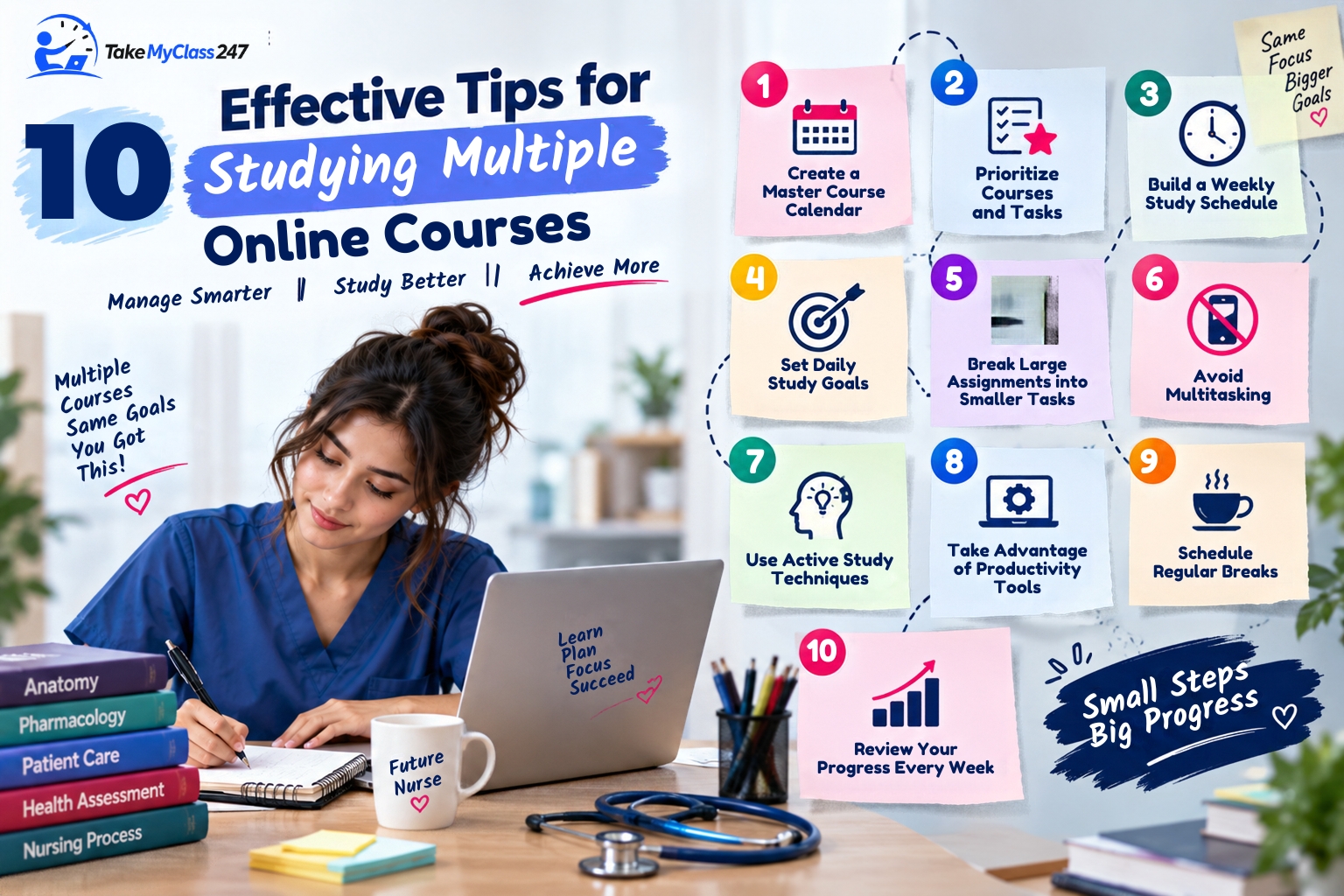
10 Effective Tips for Studying Multiple Online Courses
When you have multiple online courses to study, following these practical tips will help you manage all your tasks effectively
1. Create a Master Course Calendar
Record all your essential academic engagements in a single calendar. These can include lectures, deadlines for assignments, tests, discussions, projects, and any other mandatory activities.
Do not depend on your memory or individual course calendars. The advantage of having a master course calendar is that it helps you see your entire workload in one place. You may even color-code major deadlines to identify which weeks will be particularly busy.
2. Prioritize Courses and Tasks
Not every task needs the same level of attention at all times. So, start prioritizing your academic courses and tasks. Set high priority to tasks that are approaching the deadline, difficult/time consuming, important for your final grade, and dependent on earlier tasks being completed.
For example, a major research paper due next week may require more attention than a simple quiz due tomorrow, if the quiz can be completed quickly. Instead of simply working on whatever appears first, prioritization will allow you to make better choices.
3. Build a Weekly Study Schedule
At the beginning of each week, set a definite study time for each class. You may dedicate Monday morning to Course A readings, Monday afternoon to Course B assignments, and Tuesday morning to Course C lectures.
Note that a good schedule should contain all your classes, study times, meals, sleeping hours, work, etc. Even Cornell University’s Learning Strategies Center suggests developing a schedule with time allotted to each subject in accordance with its difficulty level and adjusting the schedule from week to week. However, try not to develop a too strict schedule; leave some open time for unforeseen tasks.
4. Set Daily Study Goals
“To study chemistry” is too broad and not a very useful goal. Instead, you should establish your goal more precisely and specifically. For example, you should set a particular target, like “Complete 20 practice problems,” “watch two lectures and take notes”, or “write the introduction to my essay”.
Specific goals will make it easier for you to begin and easily recognize when to finish a study session. Furthermore, it will help you avoid spending all evening studying without knowing what you actually need to accomplish.
5. Break Large Assignments into Smaller Tasks
Sometimes it will be challenging for you to complete large assignments or projects due to deadline pressure. In such instances, divide the task into smaller steps.
For example, if a research paper preparation task looks tough for you, then divide the activity into several steps that include topic selection, reliable sources collection, outline creation, academic paper writing, editing, and proofreading. After that, assign a separate time block for each step. Breaking assignments into smaller actions will help you reduce your last-minute stress and make your progress more visible.
6. Avoid Multitasking
Being enrolled in several courses does not necessarily mean studying several courses simultaneously.
While working on a particular task, pay your full attention to it. The continuous switching from one lecture to messages, notes, and another lecture can lower the efficiency of studying. Therefore, use focused time blocks. For example, spend 60-90 minutes on one course, take a break, and then move to another course. Cornell University’s guidance also recommends switching courses after one to two hours instead of indefinitely spending time on one subject.
7. Use Active Study Techniques
Rereading notes may cause you to feel familiar with the material, but active learning involves taking some action on the information.
Hence, when you have multiple courses to concentrate on, test yourself without looking at your notes, explain a topic using your own words, write practice questions, summarize a chapter from memory without referencing your book, and create flashcards for the key facts. By implementing active learning strategy, you can think, explain, solve problems, and apply the acquired knowledge instead of simply reviewing information passively.
8. Take Advantage of Productivity Tools
Technology can help you minimize the volume of information you need to memorize. So, you can rely on useful tools, such as digital calendars, task managers, reminder apps, note-taking systems, and course-management dashboards. But never develop a complex system that will take more time to organize than your study process.
When you use productivity tools, make sure to follow a simple approach. For example, use one digital calendar with important dates, one list of tasks for the upcoming week, and one place to keep all your course notes.
9. Schedule Regular Breaks
Working non-stop for hours does not necessarily mean that you will receive good results. Your concentration may drop during such a long process if you feel tired.
Hence, take breaks between focused studying sessions. For example, you may stand up, have a break, drink some water, or go away from the computer. Also, Cornell University’s Learning Strategies Center suggests planning real breaks and keeping individual study blocks manageable.
10. Review Your Progress Every Week
Spend 15-30 minutes every week either at the beginning or at the end to review all the courses. When you track down your weekly progress, ask yourself these questions
What did I complete?
What is overdue?
What is coming up?
Which course needs extra time?
Is my schedule realistic?
Do I need to move or reduce any tasks?
This weekly review will help you to adjust before a small problem becomes a big one.
How to Manage Multiple Online Course Deadlines
You should begin managing your online course deadlines before the due dates appear on your daily to-do list.
First, note important dates right away once you get your syllabi and course schedules. Next, prioritize your activities based on urgency, level of difficulty, and importance. Not all deadlines have equal importance or urgency.
For major assignments, set a personal deadline well before the official one. If a project is due on Friday, try to complete a draft a few days early. This will give you time to edit and resolve any unforeseen issues.
Moreover, add some buffer time into your schedule. Sometimes, technical problems, personal responsibilities, tricky reading materials, and assignments that take more time than expected can easily spoil your carefully constructed plans. Cornell’s Learning Center guidance specifically notes that students often underestimate how long academic tasks will take, so it is essential to estimate time realistically during scheduling.
How to Stay Motivated While Taking Multiple Online Courses
It will be easier to stay motivated if there is evidence of progress.
Instead of setting academic goals for the whole semester ahead, set short-term goals. For instance, try to accomplish three particular assignments during the day rather than stressing yourself about all the assignments that you should do a month ahead.
Keep track of completed assignments and study sessions. It can help you to better notice your progress by crossing off some items from the list.
Your study environment also matters the most. Keep your study area clean and well-organized, disable unnecessary notifications, and get rid of any distracting things. If it is hard to start, just decide to work on a short, focused session first. Starting is often easier when the task feels limited.
Lastly, remember to reward yourself for the progress. After accomplishing an important study session, have a walk, listen to music, chat with a friend, or spend some time on anything else you love. Small rewards can make a demanding routine feel more sustainable.
Common Mistakes to Avoid With Multiple Online Courses
Your habits will make it difficult for you to manage multiple online courses at once. Some common mistakes you should avoid include
Procrastinating: Postponing minor tasks will eventually result in a massive amount of work.
Ignoring course calendars: Overlooking a quiz or discussion assignment due date in a learning management system can easily be prevented by keeping a master calendar.
Spending too much time on one course: One difficult class could be taking up all of your time and attention while you neglect the others.
Cramming before exams: Last-minute studying will give you less time to understand the class materials and prepare for exams. Spaced review is often a preferred method of keeping track of class materials.
Sacrificing sleep: Staying up late might give you more time to study in the short run, but the consequences of doing that regularly can affect your studies.
Frequently Asked Questions
How do I manage multiple online courses at once?
If you need to manage multiple online courses simultaneously, maintain one overall calendar, develop a weekly schedule, and break down each course into smaller tasks. Specifically, focus on important and urgent tasks, while making sure that all classes get some time during the week.
How many hours should I study for multiple online classes?
There is no single number that works for everyone. The total number of hours you need to manage your workload will vary according to the difficulty of your courses, credit hours, prior knowledge, and assignment requirements. Always begin with the information your institution provides and then modify your schedule based on the real time spent on your courses.
How do I organize assignments for multiple online courses?
Put all your tasks into one task management system and track the course, activities involved, deadline, estimated time, and your current status. While organizing, divide large assignments into smaller steps and give yourself earlier personal deadlines.
What is the best study schedule for multiple online classes?
The best schedule is the one that you can follow consistently. Allocate dedicated times for each class, add breaks, revise the material, and allow some spare time for unexpected tasks.
How can I avoid feeling overwhelmed by online courses?
Stop managing your entire workload at once. Focus on deadlines, see what needs to be done right now, and concentrate on one thing at a time. A proper weekly schedule may help you with a heavy load of coursework.
Conclusion
Learning several courses via the Internet mostly depends on planning. The presence of several online courses at once may confuse you and make it hard for you to remember all deadlines and do assignments on time.
First of all, you need a master calendar, a prioritized workload, and a schedule for the week. Then you should plan your time for studying, set some particular goals, use active learning methods, take breaks, and conduct weekly reviews.
The most important thing is to make the system flexible. There may be some busy weeks when you have much work to do, and your schedule needs to be flexible enough. This way, you can keep your courses alive without being in a hurry each day. If it is still challenging for you to manage several online courses, hiring the experts from takemyclass247.com would be helpful in several ways.
Was this helpful?
⏱ 10 minutes read💬 0 comments↗ 99 shares
Related Articles
Canvas vs. Blackboard vs. Moodle: Which LMS Is Best for Online Students?
Canvas, Blackboard, and Moodle are popular learning management systems that support online coursework. If you want to know which LMS is the best for online students, make sure to compare each platform’s interface design, course organization, customization, and other specific features configured by institutions. Canvas, Blackboard, and Moodle are the three learning management […]
You must know how to avoid online class help scams to get rid of certain risks. Before you use any online class help services, carefully research the provider, verify their reviews and tutor qualifications, understand their payment and privacy policies, and also ignore unrealistic guarantees. In recent years, students have often been searching […]
How to Catch Up When You Are Behind in an Online Class
Do not quit when you cannot keep up with your online classes. If you are unsure how to catch up when you are behind in an online class, first prioritize overdue work. After that, develop a manageable schedule, study consistently, and monitor your academic progress daily. Getting behind in an online course can […]